
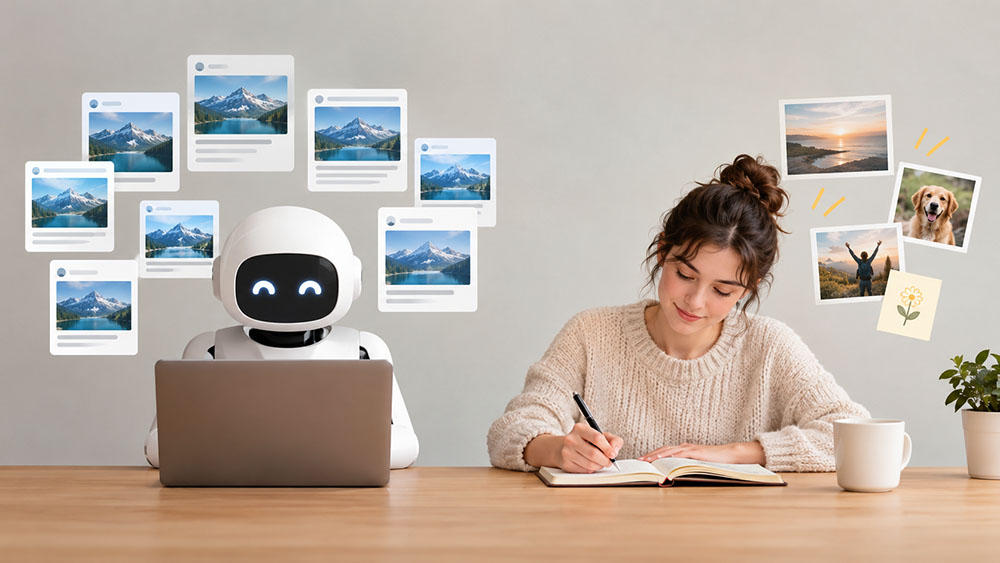
For the past few years, AI has been presented as the future of the internet. It can write articles, create images, make videos, summarize information, answer questions, and produce a social media post in seconds.
At first, it felt exciting.
Now, something has changed.
Open almost any social platform and you may find yourself scrolling past strangely perfect images, generic motivational posts, suspiciously polished LinkedIn updates, endless AI-written articles, and videos that look impressive but somehow feel completely empty.
People aren't necessarily tired of artificial intelligence itself.
They may simply be getting tired of AI-generated everything.
When the Internet Starts to Feel the Same
One of the biggest problems with AI-generated content is not that it is always bad. In fact, some AI content can be surprisingly useful or entertaining.
The problem is repetition.
AI systems are extremely good at recognizing patterns and producing content that sounds familiar. But when millions of people use similar tools to create similar things, the internet can start to develop a strangely uniform personality.
The same phrases appear again and again. The same perfectly structured paragraphs show up in different articles. The same polished images circulate across social media. Even seemingly personal posts can sometimes sound as if they were written by the same invisible author.
And that's when people start noticing something is missing.
Personality.
Welcome to the Age of “AI Slop”
You've probably seen the term “AI slop” online.
It generally refers to large amounts of low-quality, repetitive, or low-effort content produced with AI. The term has become popular because it describes something many internet users recognize immediately: content that exists mainly because it was cheap and easy to produce.
The scale is getting harder to ignore.
A recent Pew Research Center analysis of nearly half a million English-language webpages found that about one in ten pages in its July 2026 sample showed significant signs of AI authorship. Among pages published after ChatGPT became publicly available, the share was more than one-third.
That doesn't mean one-third of the internet is completely written by robots. AI detection is imperfect, and many people use AI as an editing or brainstorming tool rather than letting it create everything from scratch.
But the direction is clear: AI-assisted content is becoming a normal part of the web.
And users are starting to react.
More Content Doesn't Always Mean More Value
This is one of the strangest things about the AI boom.
AI has made producing content dramatically easier. A person can now generate ten social posts in the time it once took to write one. A business can create hundreds of product descriptions. A website can publish dozens of articles without hiring a large editorial team.
So there is more content than ever.
But more content doesn't automatically mean a better internet.
A 2026 Gartner survey found that 49% of U.S. consumers said generative AI has made the quality of available content worse. Among Gen Z and millennials, the figure rose to 57%.
That's an important distinction.
People aren't necessarily asking for less content.
They're asking for better content.
We're Starting to Look for Signs of a Real Person
When everything can be generated instantly, human imperfections become surprisingly valuable.
A slightly awkward sentence can feel more authentic than a perfectly polished paragraph.
A real photograph with imperfect lighting can feel more interesting than an impossibly beautiful AI image.
A creator talking about something that actually happened to them can be more engaging than a perfectly scripted ten-second video.
This may explain why personal stories, behind-the-scenes content, genuine opinions, and everyday experiences continue to attract attention online.
When the internet becomes flooded with synthetic content, evidence of a real human being becomes a feature.
Even mistakes can become part of the appeal.
The Irony of AI Content
There is also a funny contradiction here.
AI was supposed to help people create more efficiently. And it does.
But when everyone uses AI to save time, the internet can become filled with content that nobody really spent much time thinking about.
That's where the problem begins.
Imagine receiving 100 emails written by AI. They're grammatically perfect, professionally structured, and completely meaningless.
After a while, you might actually prefer a short message from someone who took 30 seconds to write, “Hey, I thought this might be useful for you.”
The human message wins because it feels intentional.
AI can produce words.
Humans still decide whether those words are worth reading.
This Doesn't Mean AI Is Going Away
If anything, the opposite is true.
AI is becoming deeply integrated into everyday life. People are using it for research, education, work, creativity, customer service, coding, shopping, and entertainment.
The real shift may be that people are becoming more selective about how AI is used.
Using AI to brainstorm ideas? Fine.
Using it to improve a rough draft? Helpful.
Using it to remove repetitive work? Extremely useful.
But copying the first answer from a chatbot and publishing it without checking, editing, or adding anything of your own is becoming harder to justify.
The technology isn't necessarily the problem.
The lazy use of the technology is.
The Human Advantage May Be Getting More Valuable
For years, the internet rewarded speed.
Publish faster. Post more often. Create more videos. Write more articles. Produce more.
AI has taken that philosophy to its logical extreme.
Now content can be produced almost endlessly.
That may force the internet to value something different: originality, experience, judgment, humor, personality, and trust.
A creator who has something genuinely interesting to say may stand out more than ever.
A writer with a distinctive voice may become more valuable.
A photographer who actually went somewhere may have an advantage over an account generating hundreds of beautiful imaginary locations.
And a brand that sounds like a real group of people rather than a machine may earn more trust.
Maybe the Internet Doesn't Need More Content
The AI revolution has already answered one question:
Can we create more content?
Absolutely.
The more interesting question is what comes next:
Can we create content that people actually want to spend time with?
That may become the real challenge of the next stage of the internet.
AI isn't going anywhere, and there's no reason it should. Used well, it can make people more productive and give individuals creative abilities that were previously available only to professionals.
But the internet may be entering an unexpected phase where being human becomes a competitive advantage.
After years of trying to make everything faster, smoother, and more automated, perhaps people are beginning to appreciate something much simpler:
Content that feels like someone actually cared enough to make it.