
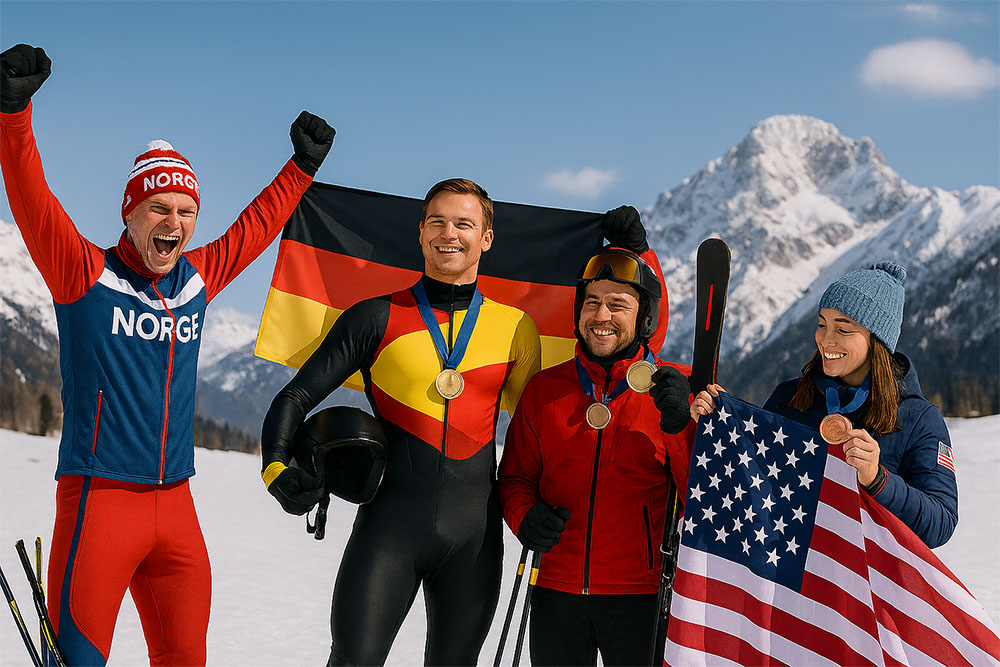
As the Milano–Cortina 2026 Winter Olympics draw global attention, one question rises above all others: Which nation will finish at the top of the medal table? Every four years, this debate sparks passionate analysis among fans, journalists, and statisticians. With 116 medal events and nearly 3,000 athletes competing, the race for the top spot is not only a matter of athletic excellence but also a reflection of national depth, training systems, and long-term investment in winter sports.
While several countries enter the Games with strong credentials, current predictions point to a familiar frontrunner—Norway—closely followed by Germany and the United States. Each nation brings its own strengths, traditions, and star athletes, making the 2026 medal race one of the most compelling in recent memory.
Norway: The Perennial Powerhouse
Norway has dominated recent Winter Olympics, and experts widely expect that trend to continue in 2026. Analysts note that only a handful of countries are truly capable of topping the medal table, and Norway stands at the forefront thanks to its extraordinary depth in skiing disciplines.
The Norwegians captured 37 medals in Beijing 2022—ten more than Germany and twelve more than the United States—setting a modern benchmark for winter sports supremacy. Their strength lies primarily in biathlon and cross‑country skiing, where they have built a dynasty through world‑class coaching, a deep talent pool, and a national culture that embraces winter endurance sports.
Sportsbooks and analysts agree: Norway is the clear favorite to win both the most overall medals and the most gold medals in 2026. Betting markets place them far ahead of their rivals, reflecting both historical performance and current athlete form.
Even with the retirement of biathlon legend Johannes Thingnes Bø, Norway’s roster remains stacked with elite performers, including cross‑country superstar Johannes Høsflot Klæbo. Their consistency across multiple Nordic disciplines gives them a structural advantage that few nations can match.
Germany: Masters of the Sliding Sports
If any nation can challenge Norway’s supremacy, it is Germany. Long known for its dominance in sliding sports—luge, skeleton, and bobsleigh—Germany enters the 2026 Games with renewed momentum. Their technical precision, engineering excellence, and deep coaching expertise have historically translated into a steady stream of medals.
Germany finished second in the 2022 medal table and is expected to remain a major contender in 2026. Their resurgence in sliding events, combined with competitive athletes in ski jumping and biathlon, positions them as Norway’s most credible challenger.
While Germany may not match Norway’s breadth across Nordic skiing, their ability to convert opportunities into medals—especially golds—keeps them firmly in the race for the top spot.
United States: Wide-Ranging Strength and Rising Stars
The United States typically casts a wider net across winter sports, competing strongly in figure skating, ice hockey, snowboarding, and alpine skiing. This broad competitive base ensures that Team USA is almost always in the top three of the overall medal count.
In 2026, the U.S. arrives with several standout athletes who could significantly boost their medal tally. Among them is Ilia Malinin, the two‑time reigning world champion in men’s figure skating. Known for his groundbreaking technical ability—including the first successful quad axel—Malinin is considered one of America’s top gold‑medal hopefuls. His Olympic debut is one of the most anticipated storylines of the Games.
The U.S. also boasts strong contenders in snowboarding, with stars like Chloe Kim expected to return to the podium, as well as rising talents in speed skating and freestyle skiing. Their challenge will be consistency: while the U.S. has many medal opportunities, converting them into golds is essential for topping the table.
Other Nations in the Mix
While Norway, Germany, and the United States form the “Big Three,” several other countries could disrupt the hierarchy:
- Canada remains a force in ice hockey, freestyle skiing, and speed skating.
- Austria excels in alpine skiing and ski jumping.
- Italy, as the host nation, hopes to leverage home advantage, though predictions place them well outside the top three.
These nations may not challenge for first place overall, but they will shape the medal landscape in key disciplines.
Why Norway Is Still the Favorite
Ultimately, predictions converge on one conclusion: Norway is best positioned to finish atop the medal table once again. Their dominance in Nordic sports provides a reliable foundation, and their athletes consistently perform at the highest level in world championships leading up to the Olympics.
Analysts estimate that a country needs around 35 medals to win the overall table—Norway surpassed that mark in 2022 and is projected to do so again in 2026.
Their combination of depth, experience, and proven performance makes them the safest bet for gold and overall medal supremacy.
A Familiar Winner, but a Thrilling Race
While Norway enters the 2026 Winter Olympics as the overwhelming favorite, the competition promises to be intense. Germany’s precision, the United States’ star power, and the ambitions of other winter sports nations will create dramatic moments throughout the Games.
The beauty of the Olympics lies in its unpredictability—new stars emerge, favorites falter, and history is written in real time. But based on current evidence, Norway stands poised to extend its reign as the world’s premier winter sports nation.