
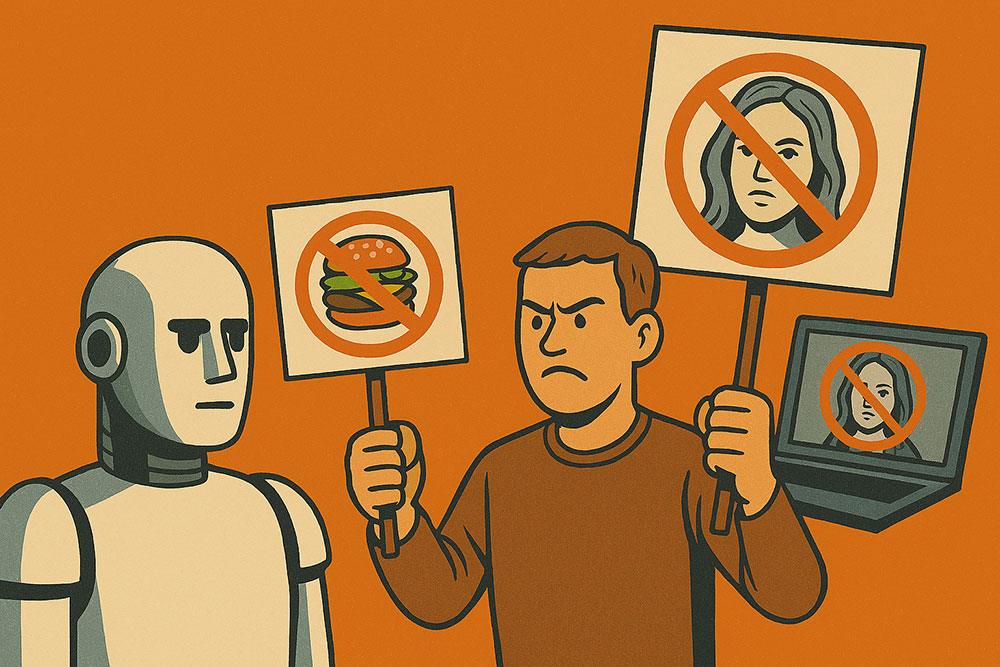
For years, the internet has been drifting toward a strange, uncanny version of itself. Search results feel thinner. Social feeds feel noisier. Advertisements look like they were assembled by a sleep‑deprived intern who has never seen a human hand before. And somewhere along the way, a new phrase entered the cultural bloodstream: AI slop.
It’s a crude term, but it captures something people have been feeling for a while — that the digital world is being flooded with content that is technically competent yet spiritually hollow. The backlash against this phenomenon didn’t appear overnight. It built slowly, like pressure under a tectonic plate, until it finally cracked open and became a global conversation.
The “AI Slop Backlash” isn’t just about technology. It’s about culture, trust, creativity, and the uneasy sense that the internet is becoming less human by the day.
The Rise of the Slop
To understand the backlash, you have to understand the slop itself.
AI slop is not simply AI‑generated content. It’s low‑effort, low‑quality, mass‑produced material that exists for no purpose other than to fill space, capture clicks, or reduce costs. It’s the kind of content that feels like it was made by someone who doesn’t care — or by no one at all.
You’ve seen it:
- The bizarre AI‑generated recipe videos with impossible ingredients.
- The corporate holiday ads where every person has seven fingers.
- The “news articles” that read like a student trying to hit a word count.
- The endless stream of AI‑generated influencers who look like they were designed by a committee of algorithms.
At first, people laughed. Then they rolled their eyes. Eventually, they got tired.
The internet has always had junk, but AI made it possible to produce junk at industrial scale. And when the volume increases, the quality of the entire environment drops. It’s like adding a few drops of dye to a glass of water — eventually the whole thing changes color.
Why People Started Pushing Back
The backlash didn’t come from a single group. It came from everywhere at once.
1. Creators felt erased
Artists, writers, musicians, and filmmakers watched as companies replaced their work with cheaper, automated alternatives. Not because the AI was better — but because it was faster and didn’t ask for a paycheck.
For many creators, the insult wasn’t just economic. It was existential. Creativity is one of the most human things we do. Seeing it automated in such a careless way felt like a dismissal of the value of human imagination.
2. Audiences felt insulted
People don’t mind AI when it’s used thoughtfully. But they do mind when brands shove lazy, uncanny content in their faces and expect applause.
There’s a difference between innovation and corner‑cutting. Consumers can tell which is which.
3. The internet became harder to trust
AI slop blurred the line between real and fake. Fake reviews, fake influencers, fake news articles, fake product photos — the digital ecosystem became a hall of mirrors.
When everything looks slightly off, people start to question everything.
4. The novelty wore off
AI‑generated content was fascinating at first. Then it became repetitive. Then it became boring. The same faces, the same styles, the same tropes — the sameness became suffocating.
People don’t crave perfection. They crave authenticity, surprise, and personality. Slop offers none of that.
The Cultural Turning Point
Every backlash has a moment when it becomes impossible to ignore. For AI slop, that moment came when major brands — the kind that usually obsess over polish — started releasing obviously AI‑generated ads.
Suddenly, the problem wasn’t fringe. It was mainstream.
When a global corporation posts an AI‑generated image with mangled limbs or surreal backgrounds, it sends a message: “We don’t care enough to hire real people.”
That message landed badly.
Consumers pushed back. Creators pushed back. Even some tech leaders pushed back, warning that the industry was drifting toward a future where everything looks the same and nothing feels meaningful.
The backlash wasn’t anti‑AI. It was anti‑mediocrity.
What the Backlash Reveals About Us
The AI Slop Backlash is, in many ways, a cultural self‑defense mechanism. It reveals a few truths about what people actually value.
We still crave human fingerprints
A painting with imperfections feels more alive than a flawless AI rendering. A story with a unique voice resonates more deeply than a generic, algorithmic imitation. People want to feel the presence of another mind behind the work.
We want technology to elevate us, not replace us
AI can be a tool for creativity, but slop represents the opposite — creativity stripped down to its cheapest form. The backlash is a reminder that people want technology to expand possibilities, not flatten them.
We’re tired of being treated like data points
AI slop often exists because someone believes audiences won’t notice or won’t care. The backlash is a collective refusal to accept that assumption.
Where We Go From Here
The backlash doesn’t mean AI will disappear. It means the era of careless AI use is ending.
We’re entering a phase where:
- Authenticity becomes a premium
- Human‑AI collaboration becomes the norm
- Audiences demand transparency
- Quality becomes a differentiator again
AI isn’t the villain. Slop is. And the backlash is a sign that people are ready to draw a line.
The internet has always reinvented itself when pushed too far in one direction. The AI Slop Backlash is simply the latest correction — a reminder that technology should serve culture, not smother it.
If anything, this moment might push us toward a more thoughtful, more intentional digital world. One where AI is used with care, creativity, and respect for the human experience.
And honestly, that’s a future worth fighting for.