
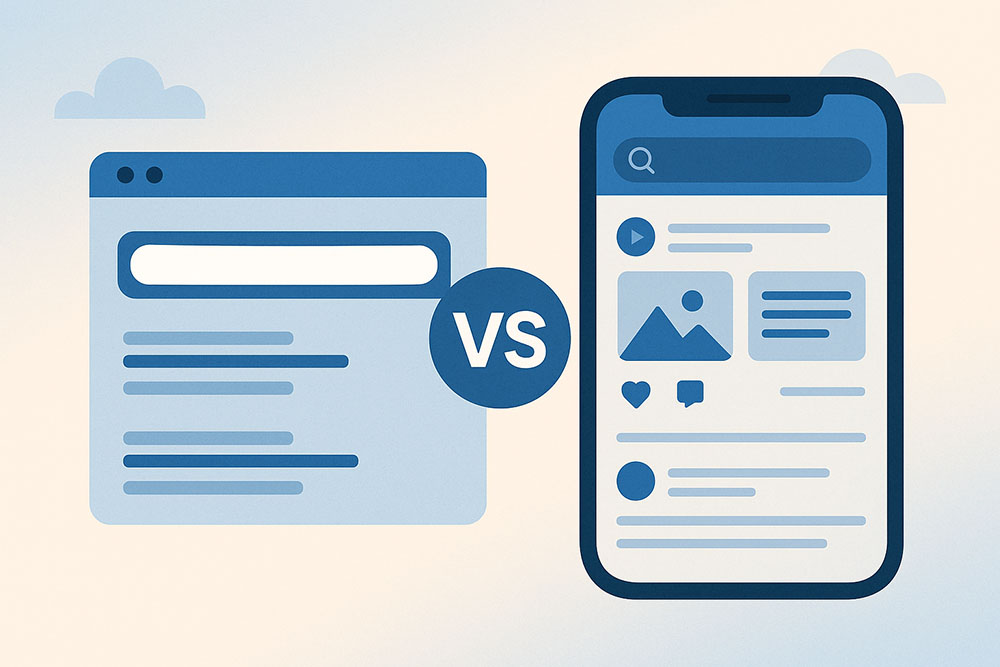
Social search has moved from a niche behavior to a mainstream discovery method, reshaping how people find information, evaluate products, and make decisions. By 2026, the shift is no longer theoretical—social platforms have become powerful search engines in their own right, driven by algorithmic personalization, creator‑generated knowledge, and AI‑enhanced content interpretation. Traditional search remains foundational, but its dominance is being challenged in ways that would have seemed unlikely a decade ago.
This article examines the current popularity and market share of social search versus traditional search, the forces driving their evolution, and the emerging search models that may define the next era of online discovery.
The Rise of Social Search
Social search refers to the use of platforms like TikTok, Instagram, YouTube, Reddit, and Pinterest as primary tools for finding information. In 2026, this behavior is no longer limited to younger users. It has become a structural shift in how people discover content.
Several trends highlight its growing influence:
- Social platforms now function as discovery engines, where users search, compare, and decide directly inside feeds.
- AI systems increasingly determine visibility and relevance, making social search more accurate and intent‑driven than in earlier years.
- Social content is now designed to be search‑friendly, with creators optimizing captions, keywords, and formats for platform‑specific search algorithms.
This shift is reinforced by user behavior: people want answers that feel authentic, contextual, and human. Social search provides real‑world demonstrations, peer opinions, and creator‑driven explanations that traditional search results often lack.
Traditional Search: Still Dominant, but No Longer Alone
Despite the rise of social search, traditional search engines remain widely used and deeply embedded in daily life. Their strength lies in structured information retrieval, comprehensive indexing, and reliability for factual or transactional queries.
Recent analyses show that:
- Traditional search has not disappeared; instead, it has expanded to coexist with AI‑driven and social‑driven discovery.
- Users still rely on Google, Bing, and similar engines for complex research, official information, and tasks requiring accuracy or breadth.
- However, the rise of conversational AI tools has begun to erode traditional search’s share of certain query types.
The most significant pressure comes from generative AI:
- In 2024, 77% of respondents reported using generative AI tools like ChatGPT instead of traditional search for some queries.
- 55% said they used AI tools instead of Google.
- 67% believed AI would replace traditional search engines within three years.
These numbers indicate that traditional search is no longer the default starting point for many users.
Comparing Popularity and Usage Share
While exact global percentages vary by region and demographic, the overall pattern is clear: social search is rapidly gaining ground, especially among younger users and in lifestyle‑driven categories.
Where Social Search Leads
- Product discovery (beauty, fashion, gadgets)
- Travel recommendations
- Tutorials and how‑to content
- Restaurant and local experience searches
- Trend‑based or culture‑driven queries
Where Traditional Search Leads
- Academic or technical research
- News and official information
- Long‑form knowledge queries
- Complex comparisons or multi‑step tasks
- Enterprise and professional use cases
Generative AI tools now sit between these two worlds, absorbing queries that require synthesis, summarization, or conversational guidance.
Why Social Search Is Growing Faster
Several structural forces explain the acceleration of social search:
- Algorithmic personalization makes results feel more relevant than generic web pages.
- Creator‑driven content provides social proof and emotional resonance.
- AI‑enhanced ranking improves the accuracy of search results within social platforms.
- Integrated commerce allows users to discover and purchase without leaving the app.
- Cultural shifts favor authenticity, lived experience, and community‑based knowledge.
These factors make social search especially compelling for everyday decisions, lifestyle choices, and trend‑driven topics.
The Future: Convergence, Not Replacement
The most important insight from 2026 is that search is not a zero‑sum game. Instead, the ecosystem is expanding into a multi‑modal, multi‑platform environment.
1. Traditional Search Will Evolve, Not Disappear
Search engines are integrating AI overviews, conversational interfaces, and multimodal results. They remain essential for structured, authoritative information.
2. Social Search Will Become Even More Intent‑Aware
AI systems on social platforms increasingly interpret user intent, making social search more precise and more personalized.
3. AI‑First Search Will Become a Third Major Category
Generative AI is emerging as a standalone search paradigm, not merely an add‑on. By 2027, over 90 million U.S. adults are projected to use generative AI as their primary search tool.
This creates a three‑pillar search ecosystem:
- Traditional search engines
- Social search platforms
- AI conversational search tools
Each serves different needs, and users fluidly switch between them.
What New Search Models Might Emerge?
Beyond social and traditional search, several new models are likely to gain traction:
1. Predictive Search
Systems that anticipate needs before users type anything, based on behavior, context, and preferences.
2. Agent‑Based Search
AI agents that perform multi‑step tasks—planning trips, comparing products, or negotiating prices—rather than returning static results.
3. Multimodal Search
Search that integrates text, voice, images, video, and real‑time sensor data into a unified discovery experience.
4. Community‑Verified Search
Platforms where results are validated by trusted communities, blending Reddit‑style discussion with structured search.
5. Hyper‑local Search
AI‑driven discovery tailored to neighborhoods, micro‑communities, and real‑time local activity.
These emerging models suggest that the future of search will be more dynamic, contextual, and personalized than anything available today.
The Bottom Line
Social search is no longer an emerging trend—it is a central part of how people discover information in 2026. Traditional search remains indispensable, but its dominance is challenged by both social platforms and AI conversational tools. The future will be defined not by one winning model, but by the coexistence and convergence of multiple search paradigms.
As search continues to evolve, the most successful platforms will be those that combine accuracy, personalization, authenticity, and context—meeting users where they are and how they prefer to discover.
Which Search Method Will Dominate the Future: Social Search or Traditional Search?