
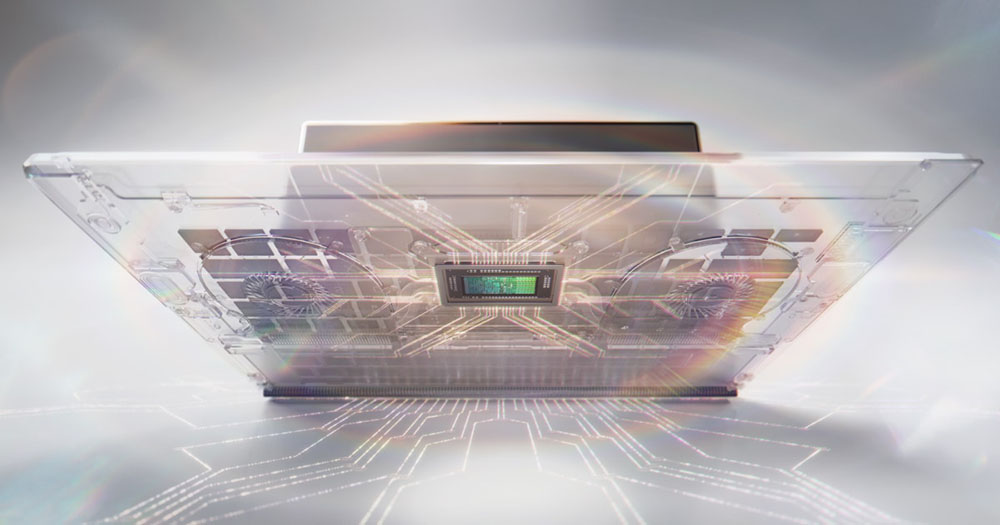
For years, the personal computing landscape has been shaped by familiar players: Intel and AMD powering most Windows machines, and Apple redefining efficiency and integration with its M‑series chips. But in 2026, something genuinely disruptive arrived — NVIDIA’s RTX Spark, a fully integrated ARM‑based superchip designed not just to run apps, but to run AI agents, massive local models, and high‑end creative workloads. And suddenly, the question isn’t whether Spark is “another chip,” but whether it marks the beginning of a new era for PCs.
NVIDIA describes Spark as “the most efficient PC chip ever built,” and early benchmarks and demos suggest that this isn’t just marketing. It’s a fundamental rethinking of what a computer should be — and it puts NVIDIA in direct competition with Apple’s M‑series for the first time.
What Makes RTX Spark Different?
At its core, RTX Spark is a superchip that merges a 20‑core Grace CPU with a Blackwell‑architecture RTX GPU, unified memory up to 128GB, and dedicated AI acceleration capable of hitting 1 petaFLOP of AI compute.
This unified design mirrors the philosophy behind Apple Silicon — CPU, GPU, and memory working as one — but Spark pushes the idea further by leaning heavily into NVIDIA’s strengths:
- Massive AI capability: Able to run 120‑billion‑parameter models locally with million‑token context windows.
- High‑end graphics: Real‑time ray tracing, DLSS, and Reflex for AAA gaming at 1440p above 100fps.
- Creator‑grade performance: Editing 12K 4:2:2 video, rendering 90GB 3D scenes, and accelerating Adobe apps rebuilt for Spark.
This isn’t a laptop chip that “can also do AI.” It’s a chip built for AI first — with everything else layered on top.
Why Spark Matters: A Shift in How We Use Computers
NVIDIA’s CEO Jensen Huang put it bluntly:
“For forty years, you launched apps. With RTX Spark, you ask, and the PC does the work.”
This is the philosophical shift Spark represents — a move from app‑centric computing to agent‑centric computing.
Instead of opening Photoshop, you might ask your PC to “clean up this image and adjust the lighting.” Instead of manually editing a video timeline, you might ask it to “cut a 30‑second highlight reel with dramatic pacing.” Instead of searching through files, your PC could proactively surface what you need.
Apple is also pushing toward on‑device AI, but NVIDIA is betting on bigger models, more context, and more GPU‑driven intelligence — all running locally.
How Does Spark Compare to Apple’s M‑Series?
Apple’s M‑series chips have dominated the conversation around efficiency, integration, and real‑world performance since 2020. The upcoming M5 continues that trend with strong single‑core performance and excellent power efficiency.
But Spark changes the competitive landscape in several ways:
1. AI Performance
Early benchmarks show Spark outperforming Apple’s M5 by 54% in developer‑focused workloads like Clang compilation, and coming surprisingly close to the M5 Pro. This suggests Spark’s 20‑core CPU and massive GPU acceleration give it an edge in parallel workloads.
2. Graphics and Creative Work
Apple’s GPUs are efficient and well‑optimized, but they’re not built for ray tracing or high‑end gaming. Spark, on the other hand, inherits the full RTX ecosystem — DLSS, ray tracing, and NVIDIA’s decades of graphics leadership.
For creators working with 3D, VFX, or high‑resolution video, Spark may become the more capable platform.
3. AI Agents and Local Models
Apple focuses on smaller, efficient models for on‑device tasks. NVIDIA focuses on huge models — 120B parameters, million‑token context — running entirely offline.
This difference could define the next decade of computing.
4. Ecosystem and Software
Apple still has the advantage in ecosystem polish and app optimization. But Microsoft is rebuilding Windows for ARM, and Adobe, Autodesk, and others are already optimizing for Spark.
The gap is closing faster than many expected.
Future Trends: Where Is This All Going?
1. AI PCs Become the Default
Spark is the first chip that makes “AI PC” more than a marketing term. Expect Windows laptops to increasingly behave like AI companions, not just productivity machines.
2. Local Models Replace Cloud AI
With Spark running 120B‑parameter models locally, cloud dependence will shrink. Privacy improves, latency disappears, and AI becomes more personal.
3. ARM Becomes the New Standard
Apple proved ARM works. NVIDIA is proving ARM can scale to AI supercomputing inside a laptop. Intel and AMD will be forced to accelerate their own transitions.
4. The Return of Real GPU Advantage
For years, integrated GPUs were “good enough.” Spark reintroduces a massive gap between consumer GPUs and everything else — especially for creators and gamers.
5. Apple vs NVIDIA Becomes the New Rivalry
For the first time, Apple faces a competitor that matches its integration philosophy and surpasses it in AI and graphics. This rivalry will define the next generation of laptops.
So… Can Spark Beat the Mac?
The honest answer: It depends on what you care about.
- If you want the most polished ecosystem and best battery life → Apple still leads.
- If you want the most powerful AI, the biggest models, the best graphics, and the most headroom for the future → Spark is already ahead.
And this is only the first generation.
Apple will respond. NVIDIA will iterate. Microsoft will optimize. But one thing is clear: the era of AI‑first personal computing has begun, and Spark is the loudest signal yet that the PC world is about to change.