
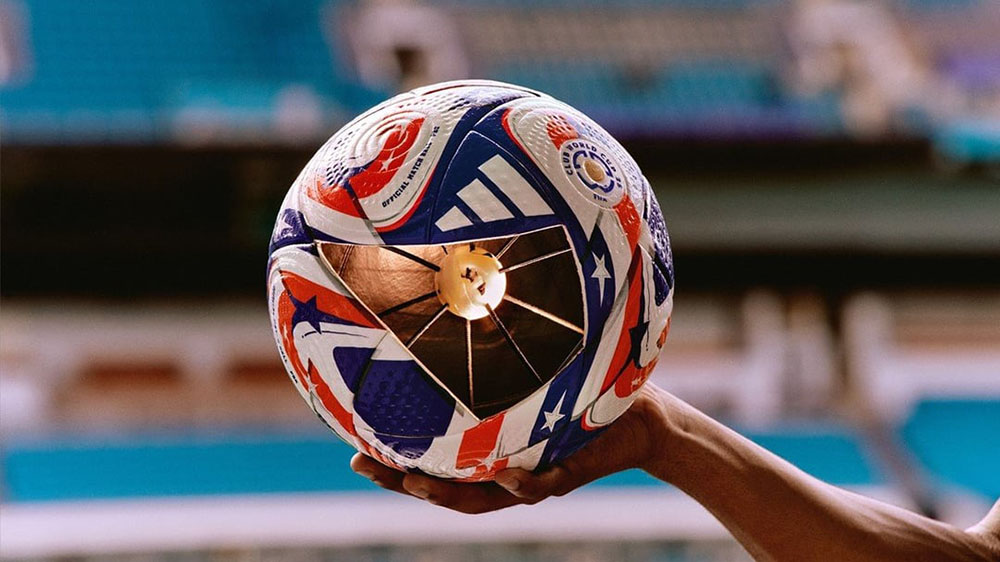
The 2026 FIFA World Cup is set to break records in scale, audience reach, and innovation. Yet among all the headlines about stadiums, teams, and AI‑enhanced officiating, one piece of technology quietly stands at the center of every match: the official match ball, Trionda. Far more than a sphere of synthetic leather, Trionda represents a leap forward in sports engineering, blending aerospace‑grade design, micro‑sensor intelligence, and climate‑adaptive testing. It is, in many ways, the smartest football ever created.
A Ball That Can “Feel” the Game
The most groundbreaking feature of Trionda is its 500Hz inertial measurement unit (IMU) embedded deep inside the ball’s core. This tiny 14‑gram sensor captures acceleration, rotation, and impact data 500 times per second, effectively giving the ball a digital nervous system. Every touch, pass, header, and shot becomes a data point.
This technology is not just a novelty. It directly supports the semi‑automated offside system (SAOT) and VAR by identifying the exact moment a player makes contact with the ball. In previous tournaments, offside decisions often hinged on frame‑by‑frame video analysis, where a single blurred frame could change the outcome. Now, the ball itself reports the truth with millisecond precision.
The IMU also helps detect handball incidents, ball possession disputes, and subtle deflections that cameras might miss. In essence, Trionda is a silent assistant referee, always watching, always measuring.
Wireless Charging and Smart Power Management
To support its sensor system, Trionda includes a wireless charging module. Before each match, balls are placed on induction pads for roughly 90 minutes, providing up to six hours of operational battery life — more than enough for a full match plus extra time.
When not in use, the ball automatically enters a low‑power sleep mode, preserving battery health and ensuring consistent performance throughout the tournament. This is the first time in World Cup history that match balls have required pre‑game charging, marking a symbolic shift from traditional equipment to intelligent sports hardware.
A Four‑Panel Revolution in Aerodynamics
Beyond electronics, Trionda’s physical design is equally innovative. Traditional footballs used 32 stitched panels; modern ones use 6–8 thermally bonded pieces. Trionda pushes this evolution further with a four‑panel construction, the fewest ever used in a World Cup ball.
Fewer panels mean fewer seams, which translates to:
- More predictable flight paths
- Reduced drag
- Better swerve control
- Lower water absorption
The ball’s surface features deep grooves and micro‑textured patterns, engineered to stabilize airflow and enhance grip in wet conditions. These textures are not decorative — they are aerodynamic tools, refined through wind‑tunnel testing and computational fluid dynamics simulations.
Tested for Every Climate in North America
The 2026 World Cup spans 16 host cities across the United States, Canada, and Mexico — a continent‑sized tournament with wildly different climates. From the humid heat of Miami to the high altitude of Mexico City and the cool rain of Vancouver, conditions vary dramatically.
For the first time ever, FIFA and Adidas conducted climate‑adaptive testing, ensuring the ball behaves consistently across:
- Temperature extremes
- High‑altitude air pressure
- Heavy rain
- Dry desert heat
This testing guarantees that players experience the same touch, bounce, and flight characteristics regardless of where they play. It also reduces the risk of unpredictable ball behavior, which has been a criticism of past World Cup balls.
A Trip to Space: NASA’s Microgravity Experiments
One of the most surprising chapters in Trionda’s development is its journey to the International Space Station (ISS). Engineers used microgravity conditions to study the ball’s center of mass, rotational stability, and sensor alignment without interference from Earth’s gravity.
This research helped optimize the placement of the IMU so that the ball remains perfectly balanced. Even with electronics inside, Trionda maintains the symmetry and weight distribution required for elite‑level play.
The result is a ball that feels natural to players while containing technology far beyond anything seen in previous tournaments.
More Than a Ball — A Data Platform
Trionda is not just a piece of equipment; it is a data platform. Every match generates millions of data points that can be used to:
- Improve officiating accuracy
- Enhance player performance analysis
- Support coaching decisions
- Provide richer broadcast graphics
- Enable new fan experiences
Imagine seeing the exact spin rate of a free kick, the acceleration curve of a counterattack pass, or the force behind a decisive header — all in real time. The 2026 World Cup will bring fans closer to the physics of football than ever before.
The Future of the Beautiful Game
The introduction of Trionda signals a broader shift in football. As sensors, AI, and analytics become more integrated into the sport, equipment will evolve from passive objects to active participants in the game’s ecosystem.
Yet despite all the technology, Trionda preserves the essence of football. Players still feel the familiar touch, weight, and responsiveness they expect. The ball does not change how the game is played — it simply reveals the game more clearly.
The 2026 World Cup will be remembered for many things, but Trionda stands out as a symbol of how tradition and innovation can coexist. It is a reminder that even the simplest objects, when reimagined with creativity and engineering, can transform the world’s most beloved sport.
Which Innovation of the 2026 World Cup Ball Impresses You Most?