
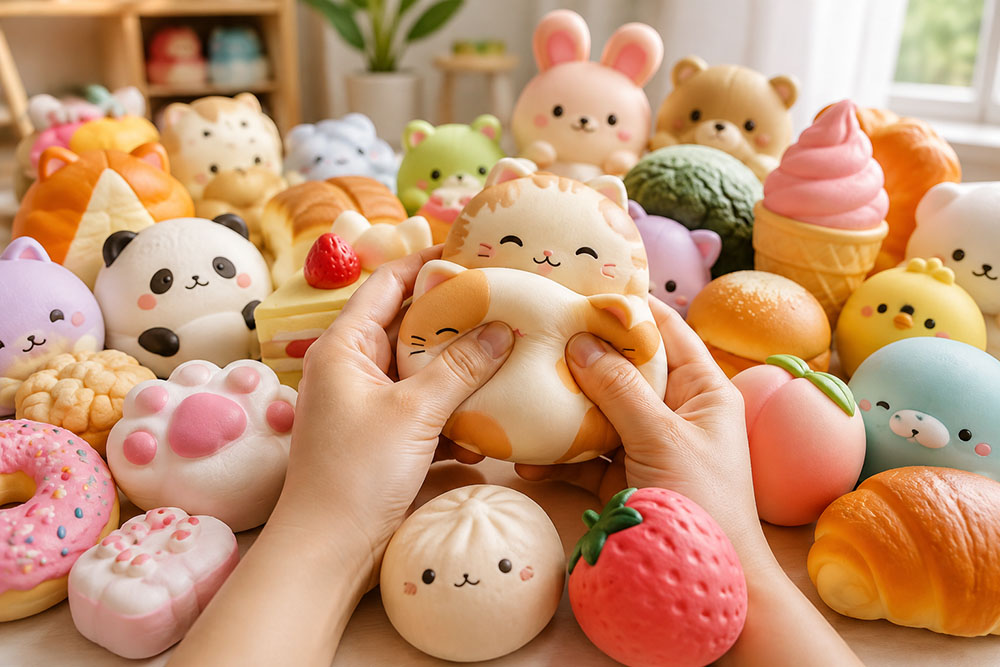
There is something strangely satisfying about squeezing a tiny piece of foam and watching it slowly return to its original shape.
Maybe that's why squishy toys, once associated almost entirely with children's bedrooms and school backpacks, are suddenly showing up everywhere again. Social media feeds are filled with people unboxing them, comparing textures, collecting miniature food-shaped versions, and filming the oddly calming moment when a squishy slowly expands back into shape.
And this time, adults are very much part of the audience.
The renewed interest isn't really about needing another toy. It's about nostalgia, stress, collecting, and the simple pleasure of doing something completely unnecessary for a few seconds.
The Toys We Thought We Had Outgrown Are Coming Back
Part of the appeal is obvious: squishy toys remind people of being younger.
Many adults who grew up with novelty toys, collectible figures, slime, fidget toys, or Japanese-inspired character merchandise are now old enough to buy those things for themselves. They don't need to ask their parents for permission or wait for a birthday.
That changes the relationship with the toy.
A miniature squishy shaped like a piece of toast might have been a silly impulse purchase as a child. As an adult, it can become a tiny desk accessory, a conversation starter, or simply something fun to keep beside a computer.
Nostalgia has also become a powerful force in fashion, beauty, music, and home décor. The return of older trends isn't necessarily about recreating the past exactly. People are taking familiar things from childhood and fitting them into adult life.
Squishy toys happen to fit that trend perfectly.
There Is Something About the Texture
The visual appeal gets people interested, but the texture is what keeps them squeezing.
Soft, slow-rising squishies provide a small amount of sensory feedback without requiring much concentration. You squeeze one, feel the resistance, release it, and watch it gradually change shape.
It's repetitive, predictable, and strangely satisfying.
That makes squishy toys part of a much broader interest in sensory objects. Fidget cubes, putty, kinetic sand, stress balls, textured keychains, and other tactile products all appeal to people who enjoy having something physical to touch while watching television, working, studying, or scrolling through their phones.
Not every adult uses these objects for stress, and they shouldn't be treated as a medical solution. But the appeal of giving your hands something simple to do is easy to understand.
Sometimes you just want to squeeze something.
Social Media Made the Experience More Interesting
Squishy toys aren't particularly new. The internet simply found a way to make them entertaining.
Short-form video is perfectly suited to objects that are satisfying to look at.
A creator can film an unboxing in a few seconds. Another person can compare five different textures. Someone else can record an entire collection arranged by color, character, or shape.
Then there are the sounds.
The soft squeeze, packaging crinkle, slow rise, and gentle tapping can all become part of the experience. This overlaps with the broader world of ASMR and satisfying videos, where the pleasure comes as much from watching and listening as from actually owning the object.
Social media also turns collecting into a public activity.
Instead of buying one squishy and forgetting about it, people can share their favorite designs, hunt for limited editions, trade with other collectors, and follow accounts dedicated entirely to miniature toys.
The object becomes part of a small online community.
Why Adults Don't Mind Spending Money on Something So Silly
There's also something refreshing about the fact that squishy toys don't have to be useful.
Adults are constantly encouraged to justify what they buy. A new kitchen gadget should save time. A fitness product should improve performance. A skincare product should solve a problem.
A tiny squishy hamburger doesn't promise to improve your life.
That's part of the charm.
It's inexpensive, playful, and completely optional. Buying one can feel less like making a serious purchase and more like giving yourself a tiny reward.
That same psychology helps explain the popularity of stickers, blind boxes, miniature collectibles, novelty mugs, and other objects that people don't technically need.
Not everything has to be productive.
The Collector Mentality Makes It Hard to Stop at One
Of course, there's another reason the trend can spread so quickly: squishy toys are extremely collectible.
Once you have one, finding another isn't difficult to justify.
Maybe the next one has a better texture. Maybe it's shaped like a dessert you actually like. Maybe it's a limited edition. Maybe it comes in a color missing from your collection.
Small objects also create a relatively low barrier to collecting. You don't need a huge room or a large budget to start building a collection.
And because many squishies are designed around food, animals, characters, or miniature everyday objects, there's almost always another theme to discover.
The collection becomes the hobby.
They're Also Perfect for the "Little Treat" Era
One of the bigger lifestyle trends of recent years has been the idea of buying small, inexpensive things simply because they make an ordinary day feel better.
A fancy coffee. A pastry after work. A new lip balm. A bouquet from the supermarket.
Squishy toys fit neatly into the same category.
They offer a tiny hit of novelty without requiring a major commitment. For someone having a stressful workday, squeezing a miniature croissant on a desk isn't going to solve the underlying problem—but it might make five minutes at the computer slightly more enjoyable.
That distinction matters.
The appeal isn't necessarily that squishies are therapeutic. It's that they can make everyday environments feel a little less serious.
The Real Trend May Be About Play
Perhaps the most interesting part of the squishy revival has nothing to do with the toys themselves.
Adults are increasingly comfortable admitting that they still enjoy things that are playful, cute, silly, or nostalgic.
That attitude can be seen everywhere: colorful fashion, nostalgic video games, collectible figurines, elaborate phone charms, miniature accessories, and childhood snacks making unexpected comebacks.
Squishy toys simply happen to be one of the most tactile versions of that trend.
You can put one on your desk, squeeze it during a meeting, throw it into a bag, or leave it sitting beside your coffee cup. It doesn't need a purpose beyond making you smile.
And perhaps that's exactly why adults are buying them again.
After years of being told that everything we do should be productive, there's something oddly appealing about owning a tiny foam hamburger that exists for no reason other than being fun.