
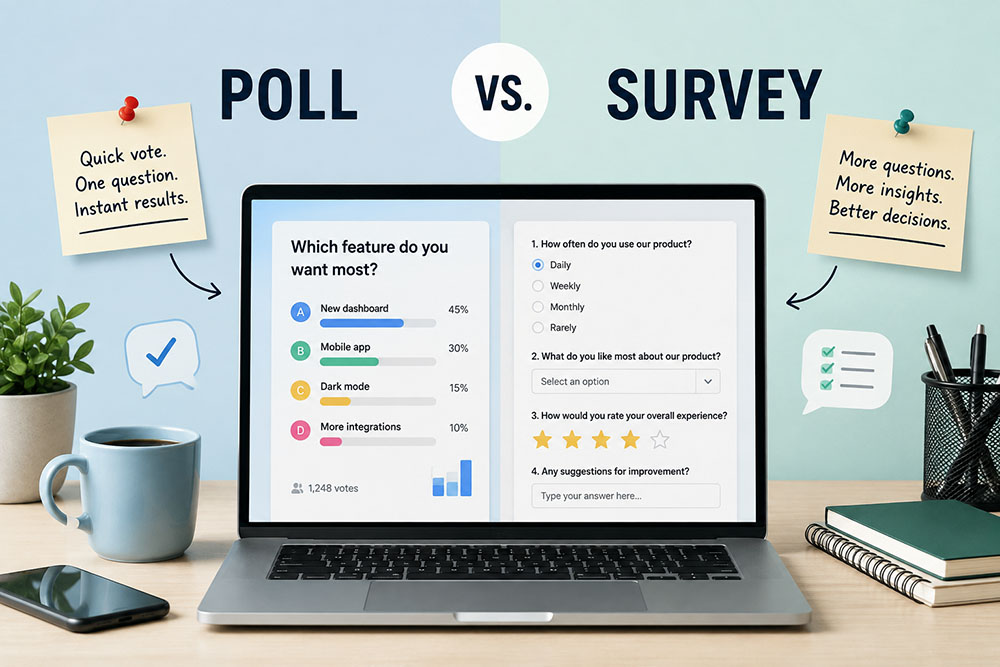
At first glance, an online poll and a survey can look almost identical. Both ask people questions. Both can be shared through a link. Both collect responses and turn them into charts or percentages.
But use them for the wrong purpose, and the difference becomes obvious.
A poll is usually about making a choice. A survey is about learning something.
That distinction sounds simple, but it affects almost everything—from how many questions you ask to how long people are willing to participate and what you do with the results afterward.
A Poll Usually Wants One Clear Answer
Imagine a lifestyle website asking:
Which summer sandal trend would you actually wear?
The choices might include fisherman sandals, leather flip-flops, jelly sandals, and suede sandals.
That's a classic online poll.
The goal isn't to build a detailed profile of every person who responds. The goal is to see which option gets the most votes.
Polls work particularly well when the question can be understood almost immediately. A reader sees the question, chooses an answer, and moves on.
This simplicity is one of the biggest strengths of an online polling system.
A good poll can take only a few seconds to complete, which makes it especially useful for websites, social communities, newsletters, media publishers, and creators who want to encourage quick interaction.
Surveys Ask for More Than a Choice
A survey usually goes deeper.
Instead of asking readers which sandal style they prefer, a retailer might ask:
How often do you buy sandals?
How much do you normally spend?
Where do you shop?
Which brands do you consider?
What matters most when choosing footwear?
How satisfied were you with your last purchase?
Now the objective has changed.
The company isn't simply trying to find the most popular answer. It's trying to understand why people behave the way they do.
That means surveys can contain multiple questions, different question types, written responses, ratings, demographic questions, and sometimes complex branching logic that changes what a person sees based on an earlier answer.
The additional detail is useful, but it also requires more effort from the person taking the survey.
The Length Changes the User Experience
This is one of the most important practical differences between a poll and a survey.
A poll generally has a low participation barrier.
You might see a question while reading an article, choose an option, and continue reading. There is little commitment involved.
A survey asks for more attention.
Even a short five-minute survey requires someone to stop what they're doing and provide several answers. Longer surveys demand even more patience.
That's why the context matters so much.
If you're trying to increase engagement on a blog post, asking one interesting poll question may be far more effective than placing a 15-question survey at the bottom of the page.
On the other hand, if you're conducting customer research, a single poll may not give you enough information to understand what is really happening.
Poll Results Are Often the Content
There's another subtle difference: poll results can become part of the experience itself.
Suppose 10,000 people vote on their favorite summer fruit.
The final result might show:
Watermelon — 42%
Strawberries — 27%
Peaches — 19%
Mangoes — 12%
The numbers aren't just useful to the person who created the poll. They're interesting to the people who participated.
Readers may want to know whether their choice is winning. They may even share the result with friends.
This creates a feedback loop:
Question → Vote → Results → Discussion
That makes online voting particularly powerful for content-driven websites and communities.
Survey results are often used differently. The people who designed the survey may spend much more time analyzing the data behind the responses rather than displaying the results publicly after every submission.
Surveys Become More Valuable When the Questions Connect
A survey doesn't necessarily need to be long, but its questions usually work together.
For example, a business might discover that customers who rate a product poorly also tend to mention shipping problems. Another group might be highly satisfied with the product but unhappy with the price.
Those relationships can be difficult to uncover with a single poll.
Survey software is therefore often built around analysis. Depending on the platform, users may have access to filtering, cross-tabulation, reports, exports, conditional logic, and other tools designed to turn individual answers into useful business information.
An online polling system generally puts more emphasis on speed, participation, and easily understood results.
Neither approach is inherently better. They're simply designed to answer different questions.
A Poll Is Better When You Want People to Participate
For publishers and community managers, this distinction can be especially important.
A poll can be attached directly to an article:
What's the first thing you do when you wake up?
Or a community might ask:
Which feature should we build next?
Or a company could let employees vote on:
Which team lunch should we order this Friday?
These questions don't necessarily require detailed research. They simply need a quick response from a group of people. That's where an online polling platform such as MiniVote can be useful, giving publishers, communities, and creators a simple way to turn a question into a quick, shareable vote without turning it into a full survey.
That makes polls a natural fit for situations where participation itself is part of the goal.
A Survey Makes More Sense When You Need to Understand Why
Now imagine a company wants to know why customers are leaving.
Asking:
Why did you cancel your subscription?
with four options could work as a poll.
But a survey could go much further.
It could ask when the customer first subscribed, how frequently they used the service, what they liked, what frustrated them, what alternatives they considered, and what might convince them to return.
The difference is essentially the difference between finding out what happened and investigating why it happened.
That deeper information can be extremely valuable for product development, market research, customer satisfaction studies, employee feedback, and academic research.
The Right Tool Depends on What You Want to Learn
The easiest way to decide between an online poll and a survey is to start with the outcome you need.
If you want people to choose, a poll is usually the better option.
If you want people to explain, a survey is likely more appropriate.
If you want to create a quick public interaction around an article, event, social post, or community discussion, an online voting system keeps the experience simple.
If you need detailed research that can be segmented and analyzed, survey software gives you considerably more room to work.
There is also nothing stopping an organization from using both.
A company might use a survey to understand customer behavior and then run a public poll to let its community choose a new product color. A media site might use surveys for audience research while using polls throughout its articles to encourage daily participation.
Sometimes One Question Is All You Need
The growing popularity of online polls says something interesting about how people interact with digital content.
Not every question needs a ten-minute survey.
Sometimes people simply want to express an opinion, see what everyone else thinks, and move on.
That's where a well-designed poll has an advantage. It respects the user's time while still turning a passive visitor into an active participant.
A survey asks for more from its audience because it is trying to learn more in return. A poll asks for less, but its simplicity can make it much easier to share, repeat, and integrate into everyday online experiences.
The best choice isn't really about whether polls or surveys are better.
It's about whether you're trying to measure a decision or understand the people making it.