
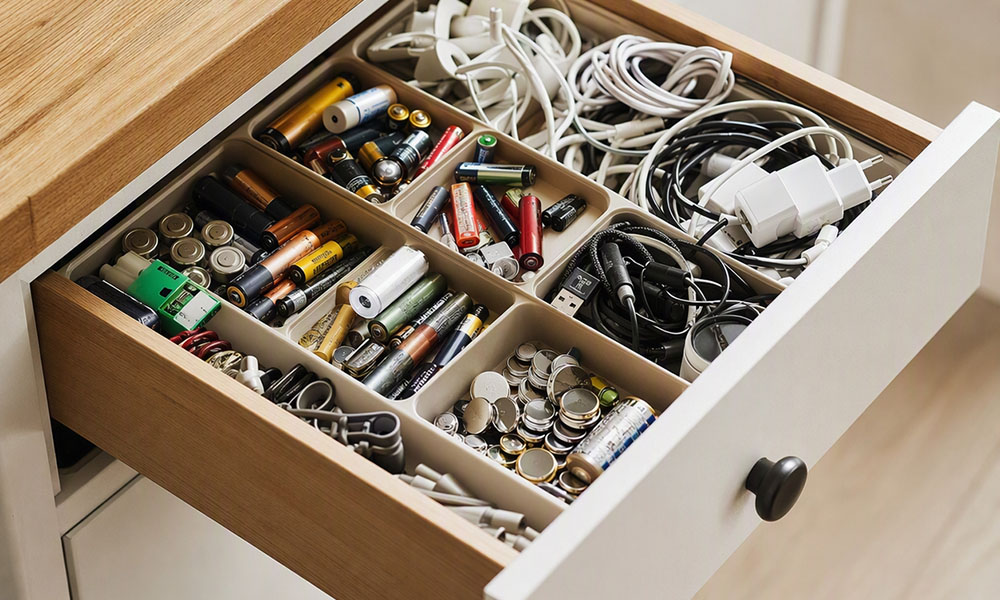
Almost every household has one.
A drawer filled with miscellaneous items that nobody quite knows what to do with.
Loose cables.
Old keys.
Instruction manuals.
A flashlight that may or may not still work.
And somewhere in the middle of it all, a small collection of used batteries.
It's such a common sight that many people barely think about it. The batteries get removed from a remote control, a toy, or a smoke alarm and then placed aside with the intention of dealing with them later.
The problem is that "later" often turns into months or even years.
For such a small object, batteries are surprisingly difficult to get rid of.
The Battery Drawer Phenomenon
One of the strange things about batteries is how easily they become permanent residents of a home.
Most people don't intentionally collect old batteries.
It just happens.
A battery dies.
You replace it.
You don't want to throw it directly in the trash because you've heard that's not the best option.
But you're also not sure where to recycle it.
So the battery gets placed somewhere temporarily.
Then another battery joins it.
And another.
Before long, an entire collection has formed.
Many households have batteries sitting untouched for far longer than anyone realizes.
Batteries Don't Feel Like Waste
Part of the challenge is psychological.
When food goes bad, people throw it away.
When packaging is empty, people recycle it.
Old batteries create uncertainty.
They don't look broken.
They don't appear dangerous.
They're simply no longer useful.
Because they still resemble functional objects, people are often reluctant to treat them like waste.
The result is a strange category of household item that feels too important to throw away but not important enough to deal with immediately.
Why Batteries Are Different From Ordinary Trash
Batteries aren't like most household items.
They're small, but they contain materials that were specifically designed to store energy.
That makes them extremely useful when powering everyday devices.
It also means they require more thought when their useful life ends.
Most people understand this instinctively.
Even if they don't know the technical details, they recognize that batteries shouldn't necessarily be treated the same way as a candy wrapper or an empty cardboard box.
That uncertainty often leads to procrastination.
Convenience Is the Real Challenge
When people talk about recycling, they often focus on motivation.
The reality is usually much simpler.
Many people are willing to recycle.
They just don't know where, when, or how.
Batteries illustrate this perfectly.
Recycling opportunities may exist in:
- Retail stores
- Community collection points
- Local recycling programs
- Household waste facilities
But if the process isn't obvious, people postpone it.
Not because they don't care.
Because life gets busy.
Convenience often determines behavior more than intention.
The Small Problem That Quietly Grows
One battery doesn't seem like a big deal.
Neither do two.
Or five.
Yet many households gradually accumulate large numbers of unused batteries over time.
Remote controls.
Wireless mice.
Toys.
Clocks.
Cameras.
Portable electronics.
Every new device eventually contributes another battery to the pile.
The longer people delay dealing with them, the larger the task feels.
Ironically, this often makes further procrastination even more likely.
A Better Approach Starts With One Container
People often assume they need a complicated recycling strategy.
Most don't.
One of the simplest solutions is creating a dedicated place for used batteries.
Instead of scattering them throughout the house, they can be collected in a single container.
That small habit offers two benefits:
First, batteries become easy to locate.
Second, the collection itself becomes visible.
Once people can actually see how many batteries have accumulated, they are far more likely to do something about it.
Sustainability Doesn't Have to Be Perfect
Modern conversations about sustainability sometimes make people feel as though every environmental choice must be perfect.
That's rarely realistic.
Most positive habits start small.
A person doesn't need to transform their entire lifestyle overnight.
Keeping used batteries separate from everyday trash is a simple step.
Learning where local recycling options exist is another.
Over time, these habits become routine rather than effortful.
The Hardest Part Is Remembering
What's interesting about battery recycling is that the biggest obstacle often isn't access.
It isn't knowledge.
It isn't even effort.
It's memory.
Once a battery disappears into a drawer, it effectively disappears from attention.
Out of sight becomes out of mind.
Weeks become months.
Months become years.
The batteries haven't gone anywhere.
People have simply stopped noticing them.
The Forgotten Items We All Have
Every home contains a few forgotten objects.
Things set aside for future action.
Things waiting to be repaired, donated, organized, or recycled.
Old batteries are among the most common examples.
Perhaps that's what makes them so interesting.
They're tiny.
They're inexpensive.
They take up almost no space.
Yet they reveal something surprisingly universal about human behavior.
We're often good at knowing what we should do.
We're not always as good at getting around to doing it.
And sometimes the simplest household items are the ones that remind us of that truth.
You Open the "Junk Drawer." What Are You Most Likely to Find?