
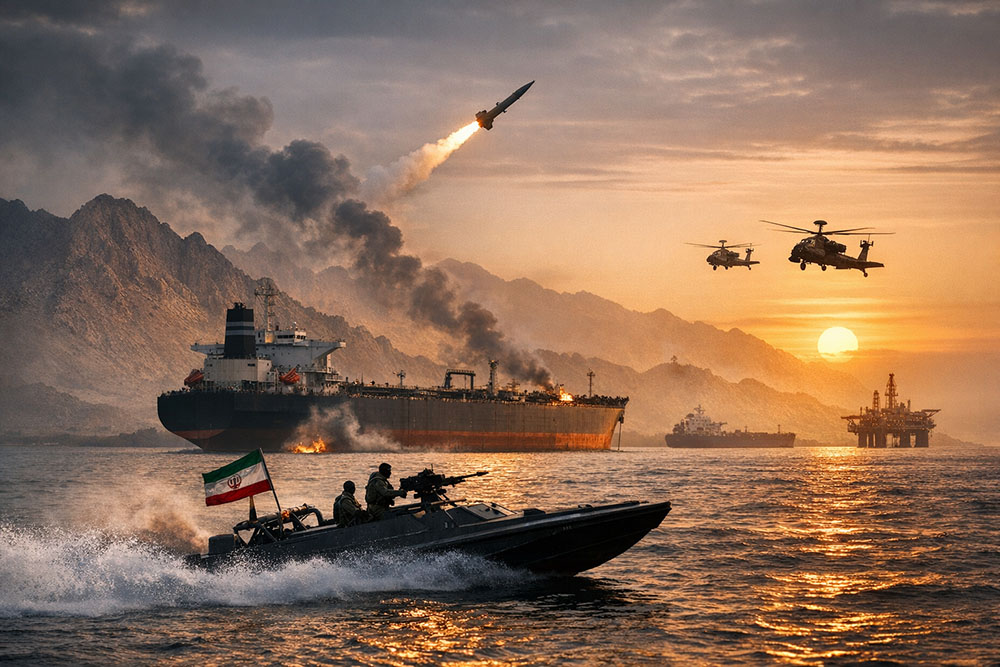
The Strait of Hormuz—one of the world’s most vital energy arteries—has once again become the center of global tension. Following coordinated U.S.–Israeli strikes on Iran, the region has spiraled into instability, pushing tanker traffic to a near standstill and sending shockwaves through global oil and gas markets. For Europe, still recovering from the energy turmoil triggered by Russia’s war in Ukraine, this new crisis could not come at a worse time.
As the conflict deepens, European governments, industries, and households are bracing for the economic consequences of rising oil and gas prices, supply disruptions, and renewed inflationary pressure. This article explores what is happening in the Strait of Hormuz, how it affects Europe specifically, and which industries are most exposed to a prolonged spike in energy prices.
1. What Is Happening in the Strait of Hormuz?
On 28 February 2026, U.S. and Israeli airstrikes on Iran triggered a rapid escalation. Iran’s Islamic Revolutionary Guard Corps (IRGC) declared the Strait of Hormuz closed, and within days, tanker traffic through the world’s most important oil chokepoint had nearly halted. At least 150 tankers were reported anchored outside the strait, unable or unwilling to pass through.
This narrow waterway—just 39 km wide at its tightest point—handles:
- 20% of global oil supply
- All LNG exports from Qatar and the UAE, representing 20% of global LNG trade
With shipping slowed to a near standstill, global energy markets have entered a period of acute uncertainty.
2. Why Europe Should Be Especially Concerned
Although Asia is the largest direct recipient of Gulf oil and LNG, Europe remains highly vulnerable to disruptions in the Strait of Hormuz. Several factors explain this heightened sensitivity:
a. Europe’s Heavy Reliance on Imported Fossil Fuels
The EU imports nearly all of its fossil fuels, leaving it exposed to geopolitical shocks. Even if Europe does not import most of its oil directly from the Gulf, global price spikes immediately affect European markets.
b. Europe’s Recent Energy Crisis Has Not Fully Healed
The continent is still recovering from the supply shock caused by Russia’s invasion of Ukraine. Gas storage, alternative LNG contracts, and renewable expansion have helped—but the system remains fragile.
c. LNG Market Tightness
Qatar is one of Europe’s most important LNG suppliers. Any disruption to Qatari LNG exports through Hormuz directly threatens Europe’s gas security. European natural gas futures have already jumped by 30% following strikes in Qatar.
d. Industrial Exposure
Europe’s manufacturing-heavy economies—Germany, Italy, France, the Netherlands—are extremely sensitive to energy price fluctuations. Higher oil and gas prices translate into higher production costs, reduced competitiveness, and potential factory slowdowns.
3. How High Could Oil Prices Go?
Oil prices have already risen sharply. Brent crude climbed from just over $73 to around $83 per barrel within days of the conflict intensifying. Analysts warn that a prolonged disruption could push prices well above $100, with some scenarios suggesting even higher spikes if the strait remains effectively closed.
Credit ratings agency Fitch notes that the disruption may be temporary, but acknowledges that current shipping constraints are already driving prices upward.
Short-term outlook (next 1–3 months):
- Continued volatility
- Prices likely to remain elevated
- Risk of sudden spikes if attacks escalate
Medium-term outlook (3–12 months):
- If the strait remains blocked or partially blocked, oil could exceed $100–$120
- LNG prices could remain highly volatile
- Europe may face renewed inflationary pressure
4. Which European Industries Will Be Hit the Hardest?
Rising oil and gas prices ripple through the entire economy, but some sectors are especially exposed.
1. Transportation & Logistics
- Higher fuel costs for trucking, aviation, and shipping
- Increased freight and insurance premiums due to heightened maritime risk
- Potential supply chain delays for imported goods
2. Manufacturing & Heavy Industry
Industries such as:
- Chemicals
- Steel
- Cement
- Automotive
- Plastics
These sectors rely heavily on energy-intensive processes. Higher oil and gas prices directly increase production costs, reducing competitiveness and squeezing margins.
3. Agriculture & Food Production
- Fertilizers are petroleum-based
- Machinery and transport costs rise
- Food prices may increase, contributing to inflation
4. Aviation
Jet fuel is one of the most oil-sensitive commodities. Airlines may face:
- Higher ticket prices
- Reduced profitability
- Potential route adjustments
5. Households & Consumer Goods
Higher energy prices feed into:
- Electricity and heating bills
- Fuel costs
- Prices of everyday goods
This can reduce consumer spending and slow economic growth.
5. What Could Europe Do Next?
European policymakers are already exploring several strategies:
a. Diversifying LNG Supply
Increasing imports from:
- The U.S.
- Norway
- West Africa
But global LNG markets are tight, and alternatives cannot fully replace Qatari volumes.
b. Accelerating the Energy Transition
Think tanks like Bruegel emphasize that Europe should double down on renewables and electrification rather than retreat from them.
c. Coordinating Strategic Reserves
EU member states may release oil from strategic reserves to stabilize markets.
d. Strengthening Maritime Security
Europe may support international efforts to secure shipping lanes, though this is politically sensitive.
6. A Critical Moment for Europe
The Strait of Hormuz crisis has exposed once again how vulnerable Europe remains to global energy shocks. While the continent has made progress in diversifying away from Russian energy, it is still deeply intertwined with global oil and LNG markets. With tanker traffic slowed to a near halt and tensions escalating, Europe faces the prospect of higher energy prices, renewed inflation, and pressure on key industries.
The coming weeks will be crucial. If the crisis eases, markets may stabilize. But if the conflict deepens or the strait remains effectively closed, Europe must prepare for a prolonged period of volatility—and potentially a new chapter in its ongoing energy crisis.
Are You Worried About Rising Oil Prices Due to the Strait of Hormuz Crisis?