
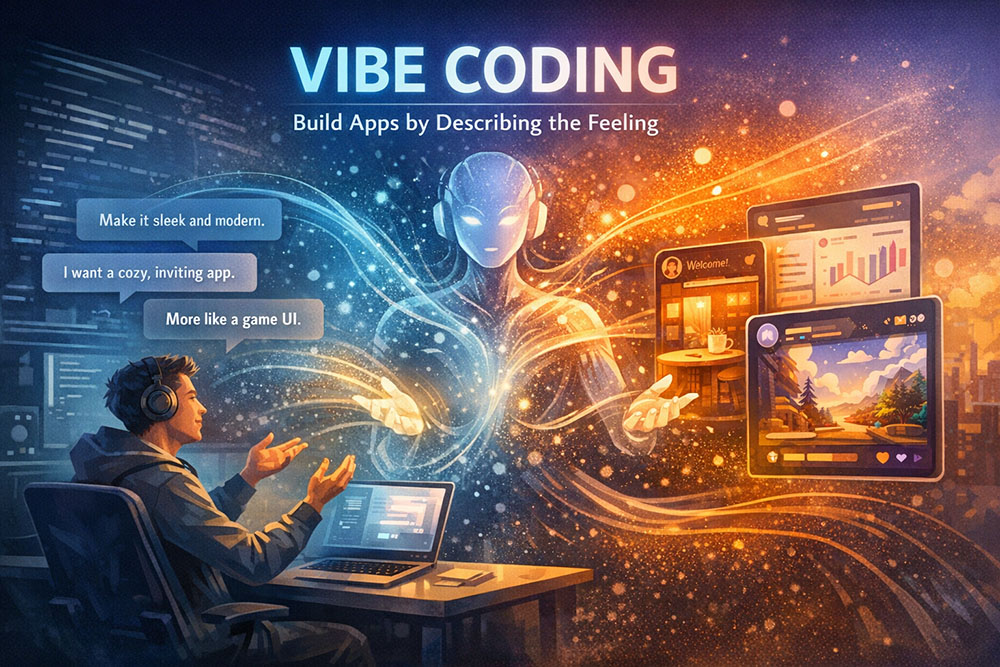
By the time 2026 arrived, the software world had quietly crossed a threshold that many developers didn’t fully recognize until they were already living in it. The shift wasn’t marked by a new programming language, a revolutionary framework, or a breakthrough in hardware. Instead, it was a transformation in how developers thought, communicated, and created. This shift came to be known as Vibe Coding—a term that started as a niche meme in early 2025 and evolved into a defining paradigm of AI‑native software development.
Vibe Coding represents a fundamental reimagining of what it means to “build software.” Instead of writing code line by line, developers describe the feeling, experience, or intent they want an application to evoke. The AI handles the rest. It’s not just code generation; it’s experience generation.
From Code to Conversation
For decades, programming was a craft defined by precision. Developers wrote instructions for machines, and machines executed them faithfully. Even with the rise of AI-assisted coding tools in the early 2020s, the workflow still revolved around code as the primary medium. Developers prompted AI to generate snippets, functions, or components, but they remained the architects and implementers.
Vibe Coding broke that pattern.
Instead of specifying what to build in technical terms, developers began describing how it should feel:
- “Give me a calm, minimalist task manager with a Zen-like flow.”
- “I want a homepage that feels like a blend of early‑2010s indie games and modern productivity apps.”
- “Make the onboarding experience warm, encouraging, and human.”
The AI interpreted these descriptions—these vibes—and generated not just UI layouts, but animations, color palettes, micro‑interactions, backend logic, and deployment-ready code. Developers shifted from writing instructions to directing an experience.
This wasn’t prompt engineering. It was vibe engineering.
Why Vibe Coding Emerged When It Did
The rise of Vibe Coding wasn’t accidental. It was the result of several converging trends:
1. Multimodal AI matured
By 2025, AI models could understand text, images, design patterns, and interaction flows simultaneously. They didn’t just generate code—they generated coherent, aesthetically aligned experiences.
2. Code generation reached production quality
Early AI coding tools were helpful but unreliable. By 2026, AI-generated codebases became stable enough for production use, with automated refactoring, testing, and debugging built in.
3. Developers became directors
A new generation of developers grew up with AI as a collaborator. They were comfortable describing outcomes rather than specifying implementation details.
4. Companies embraced AI-native workflows
Organizations realized that speed-to-market mattered more than hand-crafted code. AI-generated MVPs became the norm, and human developers focused on refinement, governance, and innovation.
Together, these forces created the perfect environment for Vibe Coding to flourish.
How Vibe Coding Works in Practice
A typical Vibe Coding session looks nothing like traditional programming. It feels more like creative direction.
A developer might begin with a broad description:
“I want a mobile app that helps users track their habits in a playful, encouraging way.”
The AI responds with a prototype: a colorful interface, animated progress rings, a friendly mascot, and a backend that stores user data securely.
The developer then refines the vibe:
- “Make it more mature and less cartoonish.”
- “Shift the color palette toward soft neutrals.”
- “Add a sense of calm and spaciousness.”
- “Make the interactions feel like a gentle nudge, not a gamified push.”
Each adjustment reshapes the entire application—UI, UX, tone, animations, and even the microcopy.
Developers no longer think in terms of components or functions. They think in terms of emotion, intention, and experience.
The Role of Code in a Vibe-Coded World
One of the most surprising outcomes of Vibe Coding is that code didn’t disappear—it simply became invisible. AI still generates code, but developers rarely touch it unless they need to:
- audit for compliance
- optimize performance
- integrate with legacy systems
- debug edge cases
Code became a medium, not a craft. It’s still there, but it’s no longer the center of the creative process.
Some developers welcomed this shift. Others resisted it, arguing that something essential was being lost. But even skeptics acknowledged that Vibe Coding unlocked a level of speed and expressiveness that traditional workflows couldn’t match.
The Cultural Impact on the Developer Community
Vibe Coding didn’t just change how software was built—it changed who built it.
People with backgrounds in design, psychology, storytelling, and product strategy suddenly found themselves able to create full applications without learning syntax or frameworks. The barrier to entry dropped dramatically.
Developers, meanwhile, found new roles as:
- experience architects
- AI supervisors
- vibe designers
- product visionaries
The identity of “developer” expanded beyond technical execution into creative leadership.
Criticisms and Challenges
Of course, Vibe Coding isn’t without controversy. Critics point to several concerns:
- Loss of craftsmanship: Some argue that removing code from the process diminishes the artistry of programming.
- Over-reliance on AI: Teams risk becoming dependent on AI-generated logic they don’t fully understand.
- Homogenization of design: If everyone uses similar AI models, will all apps start to feel the same?
- Governance and security: AI-generated code still requires rigorous oversight to ensure safety and compliance.
These debates continue, and they’re healthy. Every technological shift brings tension between tradition and innovation.
A New Creative Frontier
Despite the challenges, Vibe Coding represents a profound evolution in how humans create digital experiences. It reframes software development as a conversation—fluid, expressive, and deeply human.
Instead of wrestling with syntax, developers articulate vision. Instead of debugging for hours, they refine intention. Instead of building from scratch, they sculpt from possibility.
Vibe Coding didn’t kill programming. It expanded it.
And as 2026 continues to unfold, it’s becoming clear that this isn’t a passing trend. It’s the beginning of a new era—one where software is shaped not by code alone, but by the feelings we want it to evoke.