
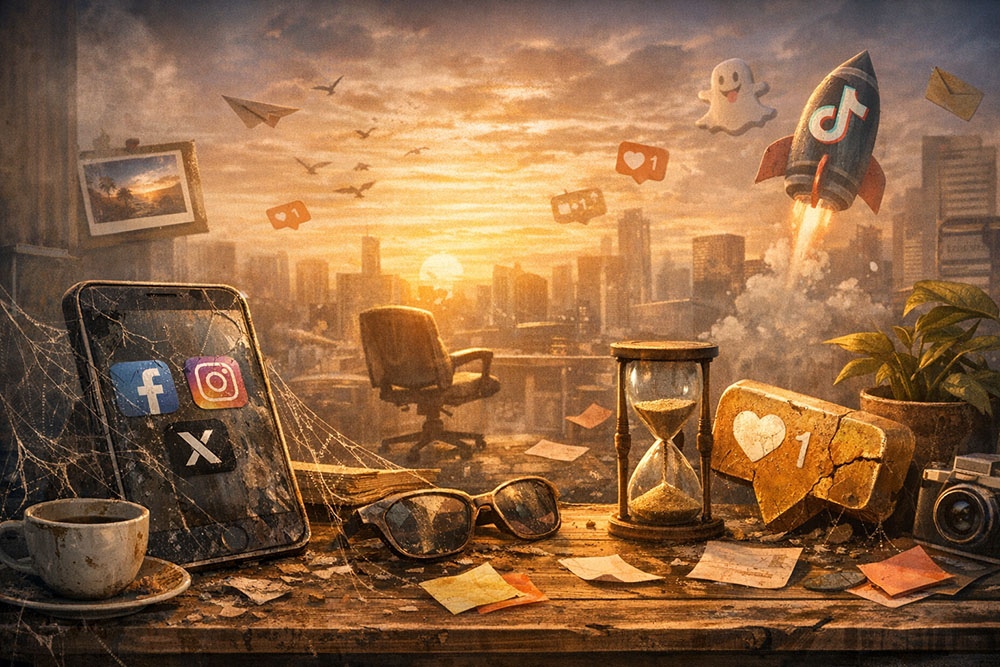
For years, social media platforms felt unstoppable — expanding, reinventing themselves, and reshaping how people communicate. But lately, something has shifted. The giants of the digital world are no longer the scrappy innovators they once were. Instead, they’re starting to resemble middle‑aged adults who suddenly wake up and wonder how they got here. Growth has slowed, younger audiences are drifting away, and the platforms themselves seem unsure of what they want to be. In other words, social media is having a midlife crisis.
This crisis isn’t about age in the literal sense. It’s about maturity, stagnation, and the uncomfortable realization that the habits and strategies that once fueled explosive success no longer work. And just like a person hitting their forties, platforms are trying everything — new looks, new features, new identities — to stay relevant.
When the Kids Move Out
One of the clearest signs of this crisis is the youth exodus. Facebook has long been the punchline of “that’s where my parents post,” but the pattern now extends far beyond it. Instagram, once the crown jewel of youth culture, is increasingly seen as polished, commercial, and exhausting. X (formerly Twitter) feels chaotic and politically charged. Even YouTube, still massive, is losing casual attention to TikTok’s hyper‑efficient algorithm.
Meanwhile, younger users are flocking to platforms that feel fresher, lighter, or more authentic — TikTok, BeReal, Snapchat, and a growing number of niche communities. The shift isn’t just about features; it’s cultural. Each platform develops a “vibe,” and once that vibe becomes associated with older generations, it’s nearly impossible to reverse.
Platforms can add new tools, redesign interfaces, or push short‑form video, but they can’t easily change the social meaning attached to them. And in the attention economy, meaning is everything.
The Weight of Endless Content
Another symptom of the midlife crisis is content fatigue. After a decade of nonstop posting, scrolling, and optimizing, users and creators alike are tired. Feeds feel repetitive. Trends cycle so quickly that nothing feels new. Creators complain that it’s harder than ever to get visibility unless they already have a massive following. Ordinary users feel like their posts disappear into the void.
The platforms themselves have contributed to this fatigue. As advertising became the dominant business model, feeds filled with sponsored posts, influencer promotions, and algorithmic recommendations. The result is a sense that social media has become less social and more transactional — a marketplace disguised as a community.
For many users, scrolling no longer feels like discovery. It feels like work.
Business Models That Show Their Age
The financial side of social media is also showing cracks. Advertising, once a goldmine, is becoming less reliable. Users are more skeptical of ads, more likely to skip them, and more aware of how their data is used. Brands are shifting budgets toward creators, influencers, and direct partnerships rather than platform‑run ad campaigns.
In response, platforms have tried to reinvent themselves as shopping hubs, entertainment networks, news distributors, creator marketplaces, and even financial services. But these expansions often feel like midlife experiments — attempts to find a new identity without fully understanding what users actually want.
The irony is that the more features platforms add, the more cluttered and confusing they become. Instead of feeling fresh, they feel bloated.
Platforms Searching for Themselves
Perhaps the most telling sign of the midlife crisis is the identity confusion spreading across major platforms.
X is trying to transform from a social network into an “everything app,” but the transition has been turbulent. Instagram can’t decide whether it’s a photo-sharing app, a TikTok competitor, or a shopping mall. Facebook has leaned heavily into community groups and local content, but in doing so has drifted far from its original purpose. Even LinkedIn, once a straightforward professional network, now feels like a mix of career advice, personal storytelling, and motivational content.
When platforms lose clarity about what they are, users lose clarity about why they should stay.
Why This Crisis Is Happening Now
Several forces are converging at once:
- Attention is finite. After years of growth, the digital attention economy has hit its ceiling. There are only so many hours people can spend online.
- AI is reshaping content creation. Generative AI makes it easier to produce content, but also easier to flood platforms with low‑effort posts. Authenticity becomes harder to find.
- Users crave smaller, safer spaces. Private groups, Discord servers, and niche communities feel more meaningful than massive public feeds.
- Cultural fatigue is real. People are tired of outrage cycles, algorithmic manipulation, and the pressure to perform online.
The crisis isn’t caused by one thing — it’s the result of a decade of accumulated habits finally catching up with the platforms that created them.
Who’s Thriving Instead
While the old giants struggle, newer or more focused platforms are thriving. TikTok continues to dominate because it feels alive — unpredictable, creative, and culturally relevant. BeReal gained traction by rejecting the polished aesthetic of Instagram. Reddit remains strong because it’s built around communities rather than personalities. Even smaller platforms like Geneva, Mastodon, and various interest‑based apps are gaining momentum.
These platforms succeed not because they are perfect, but because they offer something the older networks have lost: a sense of discovery, intimacy, or identity.
Where Social Media Goes From Here
The midlife crisis doesn’t have to end in decline. Some platforms will reinvent themselves. Others will shrink but survive. A few may fade away. But the next era of social media will likely look different from the last:
- Smaller, more meaningful communities
- Less broadcasting, more belonging
- AI‑assisted creation paired with human‑driven authenticity
- Platforms that prioritize purpose over scale
The age of “one platform for everyone” is ending. The future belongs to networks that understand who they serve — and why.
Social media isn’t dying. It’s simply growing up. And like anyone facing a midlife crisis, the real question isn’t what it used to be, but what it chooses to become next.