
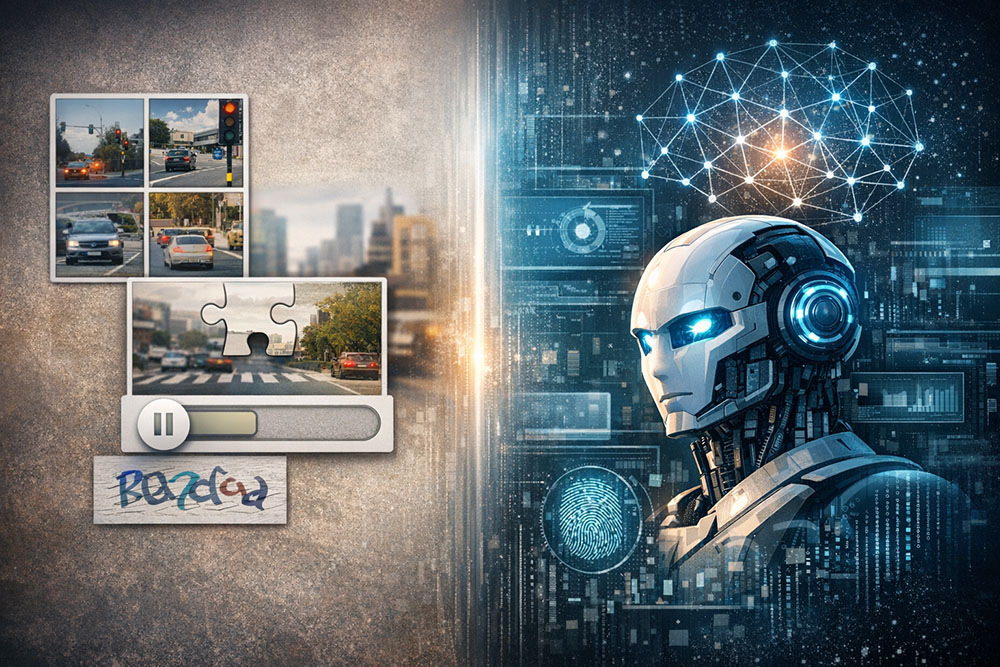
For nearly two decades, CAPTCHA systems have been the silent gatekeepers of the internet. They’ve asked us to decipher distorted letters, click on blurry traffic lights, drag puzzle pieces, and prove—again and again—that we are not robots. But in the last few years, something fundamental has shifted. The rise of advanced AI models, especially multimodal systems capable of interpreting images, text, and behavior, has pushed traditional CAPTCHA technology to the brink of irrelevance.
In the United States and Europe, this shift is happening faster than many people realize. CAPTCHA is not disappearing, but it is transforming—quietly, rapidly, and in ways that most users never see. And as AI grows more capable, the question becomes unavoidable: Can any verification system truly stop robots anymore?
Let’s explore what’s happening, how users feel about it, and where the future of human verification is heading.
The CAPTCHA Landscape in the West: A System in Transition
If you browse Western websites today, you’ll encounter a mix of old and new verification systems. But the trend is unmistakable: visible CAPTCHAs are fading, and invisible systems are taking over.
1. Google reCAPTCHA: Still Dominant, but Evolving
Google’s reCAPTCHA remains the most widely used verification system in the Western world. But even Google has moved away from the classic “click all the crosswalks” challenges.
- reCAPTCHA v2 (image selection) is still common, but widely disliked.
- reCAPTCHA v3 is now the default for many sites—completely invisible, scoring user behavior in the background.
- Enterprise reCAPTCHA adds deeper risk analysis for banks, airlines, and large platforms.
Google’s direction is clear: the future is frictionless.
2. Cloudflare Turnstile: The Rising Star
Cloudflare’s Turnstile has exploded in popularity because it offers:
- No user interaction
- No Google tracking
- Strong privacy protections
- Fast performance
For privacy-conscious European users, Turnstile is often preferred over Google’s solutions.
3. FunCaptcha (Arkose Labs): The “Playable” Alternative
Used by gaming platforms like Roblox and Xbox, FunCaptcha replaces image grids with small 3D puzzles—rotate an object, align a shape, complete a simple task.
It’s more fun, but still fundamentally a challenge-based system.
4. Enterprise Bot Mitigation (Akamai, DataDome, Kasada)
These systems rely heavily on:
- Device fingerprinting
- Behavioral analytics
- Network reputation
- Machine learning
Users rarely see a CAPTCHA at all. The system decides silently whether a visitor is trustworthy.
How Western Users Feel About CAPTCHA
Let’s be honest: most people hate CAPTCHA.
And the data backs it up.
- Studies show only 35% of users pass a CAPTCHA on the first try.
- Nearly half of users abandon a site if they fail multiple times.
- Image-based CAPTCHAs take an average of 10–15 seconds to complete.
- On mobile devices, failure rates are even higher.
In the U.S. and Europe, frustration is amplified by:
1. Privacy Concerns
Many users dislike the idea that Google is tracking their behavior across websites. This is especially sensitive in the EU, where GDPR has reshaped attitudes toward data collection.
2. Accessibility Issues
For people with visual impairments, dyslexia, or motor challenges, traditional CAPTCHAs can be nearly impossible.
3. Cultural Bias
Image CAPTCHAs often rely on American street scenes—crosswalks, fire hydrants, school buses—which can confuse international users.
4. Mobile Experience
Trying to tap tiny squares on a phone screen is a recipe for frustration.
The result? User tolerance for visible CAPTCHA is at an all-time low.
The AI Problem: Robots Are Getting Too Smart
Here’s the uncomfortable truth: AI can now solve most CAPTCHAs faster and more accurately than humans.
Recent research shows:
- Image CAPTCHAs can be solved by AI with 99% accuracy.
- Text-based CAPTCHAs are trivial for modern OCR systems.
- Behavioral CAPTCHAs can be bypassed using simulated mouse movements.
- Even puzzle-based CAPTCHAs like FunCaptcha have been reverse-engineered.
And with the rise of multimodal AI—models that can “see” and “reason”—the gap is widening.
In other words: CAPTCHA is no longer a test of human intelligence. It’s a test of whether a bot has access to a modern AI model.
That’s a losing battle.
So What Comes Next? The Future of Human Verification
The future of CAPTCHA isn’t about making harder puzzles. It’s about changing the entire philosophy of verification.
Here’s where the industry is heading:
1. Invisible Verification
The best CAPTCHA is the one users never see.
Systems will rely on:
- Device trust
- Browser integrity checks
- Network reputation
- Historical behavior
- Passive signals like scroll patterns or timing
If everything looks normal, the user passes instantly.
2. Risk-Based Scoring
Instead of a binary “human or bot,” systems will assign a risk score.
Low risk → no challenge Medium risk → light challenge High risk → strong authentication (SMS, email, MFA)
This mirrors how fraud detection works in banking.
3. Privacy-First Verification
Especially in Europe, the next generation of CAPTCHA must:
- Avoid tracking
- Avoid fingerprinting sensitive data
- Comply with GDPR and ePrivacy rules
Cloudflare Turnstile is leading this movement.
4. AI vs. AI
As bots use AI to mimic humans, verification systems will use AI to detect subtle patterns that bots can’t easily fake.
This includes:
- Micro-movements
- Timing irregularities
- Environmental signals
- Long-term behavioral consistency
It becomes a battle of models, not puzzles.
5. Integration with Identity and Security Systems
CAPTCHA will merge with:
- Multi-factor authentication
- Zero-trust security
- Account reputation systems
- Fraud detection engines
Verification becomes part of a broader security ecosystem.
Will CAPTCHA Ever Truly Stop Bots Again?
The honest answer is: not perfectly.
But that’s not the goal anymore.
The goal is to make automated abuse:
- Expensive
- Slow
- Detectable
- Unprofitable
Bots don’t need to be stopped entirely—they just need to be pushed out of the cost-benefit range.
And invisible, AI-driven verification systems are far better suited for that than the old “click the traffic lights” puzzles.
CAPTCHA Isn’t Dying—It’s Evolving
The Western internet is moving into a new era of human verification. Traditional CAPTCHAs are fading, not because they’re inconvenient, but because they’re obsolete. AI has outgrown them. Users resent them. And modern security demands more subtle, intelligent, privacy‑respecting solutions.
The future of CAPTCHA is invisible, behavioral, and deeply integrated into the fabric of online trust.
In short: CAPTCHA isn’t going away—it’s becoming something entirely different.