
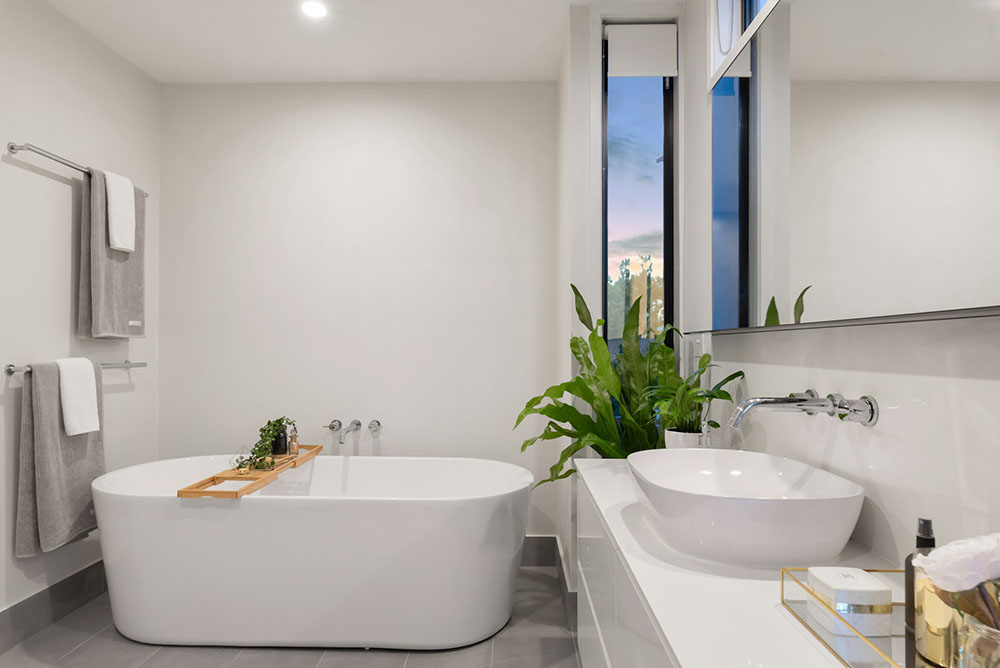
When people renovate a small bathroom, the goal is usually obvious.
Make it feel bigger.
Yet many bathroom renovations achieve the exact opposite result.
The surprising part is that the problem often isn't the room itself. In many cases, the bathroom hasn't actually become smaller. It simply feels smaller because of a few design decisions that unintentionally reduce the sense of space.
A well-designed bathroom doesn't need extra square footage to feel comfortable. Sometimes the biggest improvements come from avoiding a handful of common mistakes.
1. Choosing an Oversized Vanity
A large vanity can look impressive in a showroom.
In a small bathroom, however, it can quickly become the dominant feature in the room.
One of the most common mistakes homeowners make is selecting a vanity based on storage needs alone without considering how much floor space it occupies visually.
When a vanity extends too far into the room, everything begins to feel tighter:
- Walkways become narrower
- Sightlines become shorter
- The room feels more crowded
In small bathrooms, a slightly smaller vanity often creates a disproportionately larger feeling of openness.
2. Using Dark Colors Everywhere
Dark colors can be beautiful.
Black fixtures, charcoal walls, and deep navy tiles have all become popular in recent years.
The problem isn't the color itself.
The problem is using dark tones on nearly every surface in a small room.
Dark colors absorb light rather than reflect it. When walls, floors, cabinetry, and accessories all share darker shades, the boundaries of the room can feel heavier and more enclosed.
A small bathroom can absolutely incorporate dark accents.
The key is balance.
3. Installing a Mirror That's Too Small
Many people underestimate how important mirrors are in small spaces.
A mirror does more than help with daily routines.
It reflects light.
It extends sightlines.
It creates the impression of additional depth.
A tiny mirror above the sink may technically do its job, but it misses one of the most powerful visual tools available in a compact bathroom.
In many cases, a larger mirror can make a room feel significantly more spacious without changing a single wall.
4. Breaking Up the Space With Too Many Patterns
It's tempting to add personality through:
- Decorative tiles
- Accent walls
- Patterned floors
- Contrasting materials
Individually, these elements can look great.
The issue arises when too many of them compete for attention at once.
Every major visual transition divides the room into smaller sections.
The eye has less opportunity to travel naturally through the space.
As a result, the bathroom often feels busier and smaller than it actually is.
A simpler visual flow typically helps compact spaces feel larger and calmer.
5. Installing a Bulky Shower Enclosure
Shower enclosures can dramatically influence how large a bathroom appears.
Heavy frames, thick borders, and visually solid barriers interrupt the flow of the room.
Even when the shower itself isn't large, the enclosure can create the impression of multiple separate spaces rather than one continuous space.
Many modern bathrooms use large glass panels because they allow the eye to see more of the room at once.
The more visual barriers removed, the larger the space tends to feel.
6. Ignoring Lighting
Poor lighting is one of the fastest ways to make a bathroom feel cramped.
A room can have excellent layout, beautiful materials, and smart storage, yet still feel small if it's poorly lit.
Many bathrooms rely on a single overhead fixture.
This often creates shadows that visually shrink the space.
Good bathroom lighting typically combines multiple light sources:
- Overhead lighting
- Mirror lighting
- Accent lighting
- Natural light when available
The goal isn't simply brightness.
The goal is reducing dark corners and creating a more open atmosphere.
7. Leaving Everything on Display
Even a reasonably sized bathroom can feel crowded when every available surface is covered.
Toothbrushes.
Skincare products.
Hair tools.
Cleaning supplies.
Extra towels.
When too many items remain visible, visual clutter accumulates quickly.
The human eye interprets clutter as a reduction in available space.
This is why effective storage can make a bathroom feel larger without changing anything physically.
Sometimes removing a few items from view creates a bigger impact than adding new design features.
Small Bathrooms Are Often a Visual Challenge
Many homeowners assume the biggest limitation of a bathroom is its square footage.
In reality, perception plays a surprisingly important role.
Two bathrooms of identical size can feel completely different depending on:
- Lighting
- Colors
- Layout
- Storage
- Material choices
The most successful small bathrooms don't necessarily have more space.
They simply make better use of the space they already have.
Bigger Isn't Always Better
When renovating a bathroom, it's easy to focus on individual features.
A bigger vanity.
More storage.
Larger fixtures.
Extra decoration.
Yet creating a comfortable room often requires the opposite mindset.
The best small bathrooms aren't filled with more things.
They're designed to feel effortless.
Good design doesn't magically add square footage.
It simply removes the visual obstacles that make a space feel smaller than it needs to be.
And in a compact bathroom, that difference can be enormous.