
A kitchen is never just a kitchen.
At first glance, cookware appears purely functional — a knife cuts, a pot boils, a pan heats. But when you compare kitchens across cultures, something deeper emerges. The shape of a pan, the weight of a knife, the material of a pot — these are not random choices. They reflect how a society understands food, time, labor, and even life itself.
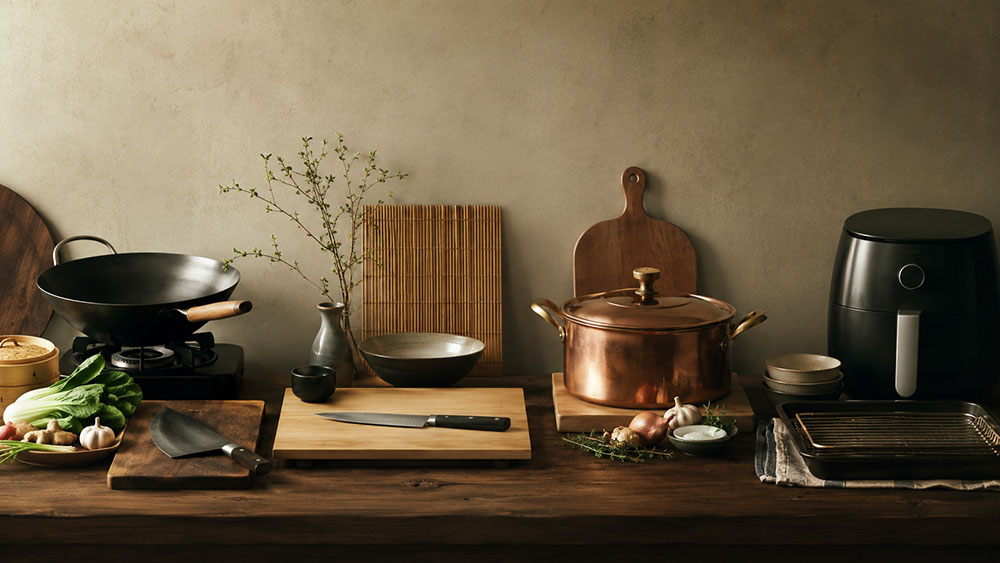
Different civilizations did not simply invent different cuisines. They developed distinct philosophies of cooking, and those philosophies became embedded in the tools people use every day. A Chinese wok, a Japanese sashimi knife, a French copper pot, and an American air fryer are not merely utensils; they are cultural artifacts shaped by geography, fuel, social structure, economics, and taste.
Nowhere is this clearer than in the kitchens of China, Japan, France, and the United States.
China: Fire, Speed, and Transformation
Chinese cooking is inseparable from fire. In a traditional Chinese kitchen, the wok dominates. Thin, rounded, and highly responsive to heat, it embodies the core principles of Chinese cuisine: speed, versatility, and mastery over intense flame.
The wok’s design emerged from necessity. For centuries, wood and charcoal were scarce and expensive. Cooking had to be fast and fuel‑efficient. A carbon steel wok heats and cools rapidly, allowing large quantities of food to be cooked quickly with minimal fuel. Stir‑frying became widespread not only because it tasted good, but because it was practical.
Over time, this practicality evolved into artistry. “Wok hei” — the smoky, elusive flavor produced by extremely high heat — is a hallmark of Chinese cuisine. Achieving it requires speed, movement, timing, and direct contact with flame. It cannot be replicated by slow cooking.
Chinese cookware therefore emphasizes adaptability over specialization. A single wok can stir‑fry, deep‑fry, steam, boil, braise, and smoke. The Chinese cleaver, despite its name, is a multi‑purpose tool: it slices vegetables, chops meat, crushes garlic, and transfers ingredients. One knife is expected to do the work of many.
This reflects a broader philosophy: efficiency through skill. Rather than relying on numerous specialized tools, Chinese cooking depends on a few flexible ones used with mastery. The cook matters more than the equipment.
Communal dining also shaped Chinese kitchen tools. Because dishes are shared, food is cut into bite‑sized pieces before cooking, reducing cooking time and eliminating the need for knives at the table. The kitchen becomes the primary site of transformation.
In essence, the Chinese kitchen is built around rapid change through heat — a dance of flame, oil, and motion.
Japan: Precision, Purity, and Respect for Ingredients
If Chinese cooking celebrates transformation, Japanese cooking celebrates preservation.
Japanese cuisine places extraordinary emphasis on maintaining the natural flavor, texture, and appearance of ingredients. This philosophy shaped the development of Japanese kitchen tools more than anything else.
The clearest example is the Japanese knife. Unlike the versatile Chinese cleaver, Japanese knives became increasingly specialized: knives for slicing fish, filleting fish, cutting vegetables, preparing eel, or creating translucent sashimi. Many are sharpened on only one side to allow for extremely precise cuts.
In Japanese cuisine, cutting is not just preparation — it is part of the final taste. The texture of sashimi changes depending on the angle and smoothness of the slice. Precision matters because subtlety matters.
Japanese cookware reflects the same values. Tools tend to be smaller, lighter, and more refined. Rectangular pans exist solely for tamagoyaki. Donabe clay pots provide gentle, even heat for delicate simmering. Bento boxes organize food visually as much as functionally.
Aesthetic consciousness runs through the Japanese kitchen. Cooking is not only about flavor but also balance, seasonality, and visual harmony.
Japan’s restrained approach to heat also stems from geography. As an island nation with abundant seafood and fresh produce, Japan developed a culinary culture that values purity and minimal interference. Tools are designed to reveal ingredients, not transform them.
Craftsmanship plays a major role as well. Many traditional knives are still handmade by artisans whose techniques descend from samurai sword‑making. A Japanese knife carries cultural meaning far beyond its practical use.
The Japanese kitchen is therefore built on precision, restraint, and respect — a philosophy that seeks to highlight what ingredients already are.
France: Stability, Patience, and the Architecture of Flavor
French cookware feels fundamentally different from Asian cookware the moment you pick it up — it is heavier.
French culinary traditions developed around ovens, slow reductions, braising, and layered flavor construction. As a result, French cookware prioritizes thermal stability rather than rapid responsiveness. Thick copper, cast iron, and heavy steel are common because they retain and distribute heat evenly over long periods.
A cast‑iron Dutch oven, for example, is ideal for stews and braises where consistency matters more than speed. French cuisine builds flavor gradually: onions caramelize slowly, stocks simmer for hours, sauces reduce with careful attention.
French cooking is architectural. Each step contributes to a final structure of flavor. Unlike the explosive immediacy of stir‑frying, French cuisine rewards patience.
This philosophy produced some of the world’s most iconic cookware traditions. Copper pans became prized for their ability to respond quickly to temperature adjustments while maintaining even heat — essential for delicate sauces and pastry work.
French kitchens also reflect the rise of professional restaurant culture. France played a central role in developing modern haute cuisine and formal culinary training. As a result, French cookware is associated with discipline, organization, and technical precision.
Sauces further distinguish French cooking. In Chinese cuisine, sauces are often integrated quickly during cooking. In French cuisine, sauces can be elaborate creations requiring their own techniques and dedicated cookware for reduction, emulsification, and controlled simmering.
The French kitchen is a laboratory of slow, deliberate transformation.
The United States: Convenience, Scale, and Industrialized Cooking
American kitchens reveal the influence of modern industrial society more clearly than any other.
Unlike older culinary traditions shaped by scarcity, American kitchen culture developed alongside mass production, suburban living, electricity, and consumer appliances. As a result, American cookware prioritizes convenience, efficiency, and scale.
Modern American kitchens are filled with machines: air fryers, slow cookers, stand mixers, microwaves, coffee makers, blenders, food processors, pressure cookers, and oversized refrigerators. Many homes contain more appliances than traditional cookware.
This reflects both lifestyle and economics. Postwar suburbanization created larger homes with spacious kitchens. Consumer culture encouraged specialized appliances. As dual‑income households became common, time‑saving tools grew essential.
American cooking therefore shifted toward automation. The air fryer is the perfect symbol: fast, convenient, easy to clean, and designed to simplify cooking. Instead of mastering fire or knife technique, users operate systems.
This does not mean American cuisine lacks creativity — it is highly innovative, absorbing influences from around the world. But the tools themselves prioritize accessibility over tradition.
Scale is another defining feature. American ovens are large because American portions are large. Outdoor grilling culture flourished because suburban homes had private yards. Barbecue equipment evolved into a lifestyle category associated with leisure and social gatherings.
The American kitchen is deeply tied to consumer identity. Gadgets are marketed as lifestyle upgrades. Cooking becomes linked to productivity, wellness, and personal optimization.
In many ways, the American kitchen is shaped less by ancient culinary philosophy and more by technological culture. It asks:
“How can cooking become easier?” rather than “How should ingredients be transformed?”
What These Kitchens Reveal
Behind every pan, knife, and stove lies a civilization’s relationship with time, labor, nature, and taste.
- China developed tools for speed, flexibility, and mastery over intense heat.
- Japan developed specialized tools for precision, subtlety, and respect for ingredients.
- France built heavy cookware for slow refinement and layered flavor.
- America embraced appliances and automation to match modern life’s pace and scale.
None of these systems is superior. Each evolved logically within its own environment.
Cookware preserves cultural memory. A wok carries the logic of fire‑based street cooking. A Japanese knife reflects centuries of craftsmanship. A French copper pot represents patience and technique. An American air fryer reflects the modern desire to save time.
Kitchen tools are not just objects. They are physical expressions of how societies believe people should cook, eat, gather, and live.