
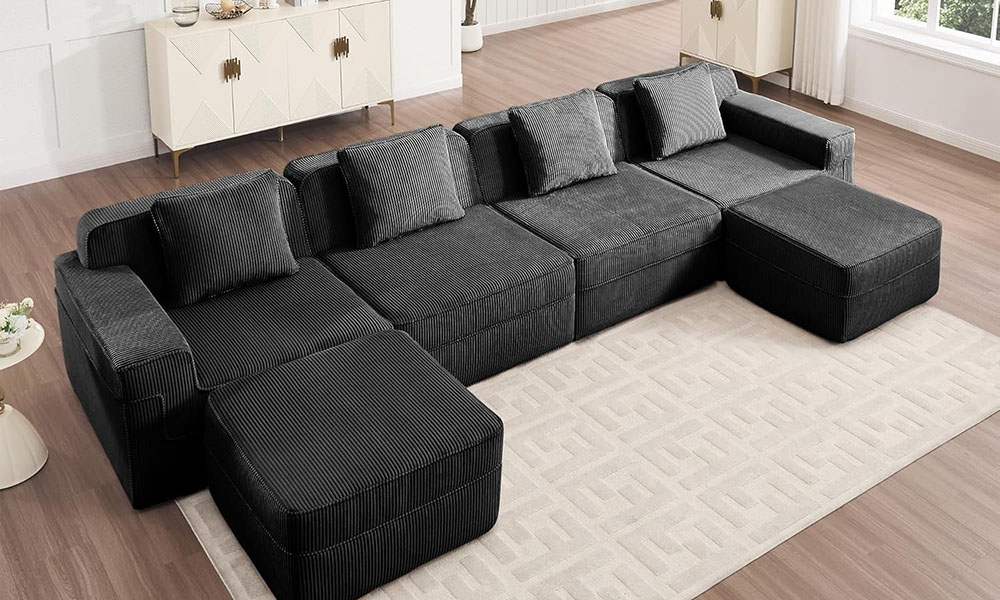
It started with a viral TikTok clip: a young woman sinking into what looked less like a sofa and more like a giant marshmallow. No sharp edges, no rigid frame — just a cloud‑like cushion that swallowed her whole. Within days, the phrase “boneless couch” began circulating online, and suddenly everyone wanted one.
The name sounds playful, even absurd, but it perfectly captures the essence of this new furniture phenomenon. A boneless couch is, quite literally, a couch without bones — no wooden skeleton, no metal structure, no hard lines. It’s all foam, fabric, and freedom.
A Couch That Feels Like a Hug
Traditional sofas are built to support posture and define space. The boneless couch does the opposite. It invites you to collapse, curl up, and forget about structure altogether. Most models are made from layers of high‑density foam or memory foam, wrapped in soft, neutral‑toned fabric — beige, cream, or dusty gray. They sit low to the ground, often without arms or legs, creating a seamless flow between the couch and the floor.
The result is a piece of furniture that feels more like a hug than a seat. It’s cozy, pliable, and forgiving — a physical manifestation of the “do‑nothing” aesthetic that has taken over social media.
Why It Went Viral
The boneless couch didn’t rise to fame because of clever marketing alone. It hit a cultural nerve.
After years of pandemic lockdowns, people began rethinking what comfort means. Homes turned into sanctuaries, and furniture became emotional rather than functional. TikTok creators filmed themselves melting into their couches after long workdays, captioning clips with phrases like “this couch understands me.” The videos resonated.
The couch became a metaphor for softness — not just physical, but psychological. In a world that often demands productivity and perfection, the boneless couch offered permission to be lazy, messy, and human.
The Aesthetic of Soft Minimalism
Designers quickly noticed that the boneless couch fits perfectly into the broader trend of soft minimalism — a style that favors rounded edges, muted tones, and tactile materials. Unlike the cold, rigid minimalism of the early 2010s, soft minimalism feels warm and approachable.
The boneless couch embodies that shift. It’s minimal in form but maximal in comfort. It doesn’t shout for attention; it whispers calm. Paired with plush rugs, diffused lighting, and oversized blankets, it creates an environment that feels safe and slow — a visual antidote to the chaos outside.
A Reflection of Modern Living
There’s also a practical side to the boneless couch’s appeal. Many young adults live in small apartments or rented spaces where heavy furniture is a burden. A boneless couch is lightweight, easy to move, and often modular. You can reshape it, stack it, or even sleep on it.
It’s the perfect companion for a generation that values flexibility over permanence. In that sense, the couch mirrors the lifestyle of its audience — adaptable, transient, and comfort‑driven.
The Psychology of Softness
Psychologists have long noted that tactile experiences influence mood. Soft textures can trigger feelings of safety and relaxation, while hard surfaces evoke alertness and control. The boneless couch taps directly into this sensory psychology.
When you sink into it, your body releases tension. The absence of structure becomes a kind of therapy — a reminder that not everything needs to be rigid or defined. It’s no coincidence that many people describe their boneless couch as “healing.”
Critics and Counterpoints
Of course, not everyone is convinced. Some interior designers argue that the boneless couch is more fad than furniture — impractical, lacking support, and destined to lose shape over time. Others see it as a symptom of cultural escapism: a desire to retreat from reality into softness.
But even critics admit that the couch’s popularity says something meaningful about the moment we’re living in. It’s not just about sitting; it’s about feeling.
From Meme to Movement
What began as a meme has evolved into a movement. Brands now compete to design their own versions — from minimalist foam blocks to luxurious oversized loungers. Influencers host “boneless nights,” where friends gather to watch movies sprawled across a sea of cushions. Interior magazines feature them as symbols of “radical comfort.”
The boneless couch has become more than furniture. It’s a cultural statement: a rejection of rigidity, a celebration of softness, and a quiet protest against the pressure to always sit up straight — metaphorically and literally.
Comfort as a Philosophy
In the end, the boneless couch isn’t just about design. It’s about redefining comfort as a philosophy. It asks a simple question: What if home could be a place where you don’t have to hold yourself together?
That idea — gentle, human, and oddly profound — explains why this shapeless piece of foam has captured so many hearts. It’s not perfect, and it doesn’t pretend to be. It’s soft, forgiving, and a little bit silly. And maybe that’s exactly what we need right now.