
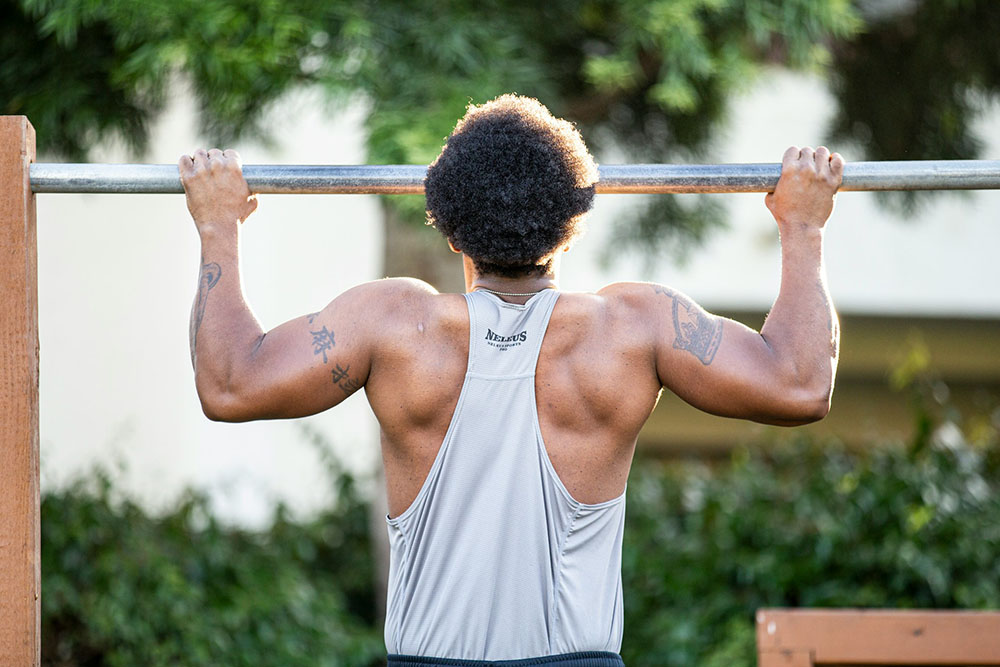
You grab the pull-up bar, take a deep breath, and pull as hard as you can.
Nothing happens.
Maybe your elbows bend slightly. Maybe your shoulders move a little. But your body stays exactly where it started.
If you've ever experienced this, you're definitely not alone. Pull-ups are one of those exercises that look simple but require a surprising combination of strength, coordination, and body control. Being unable to do one doesn't necessarily mean you're out of shape. It simply means your body hasn't developed the specific strength needed for the movement yet.
The good news? You don't need to be able to do a pull-up before you start training for one.
A Pull-Up Is More Than an Arm Exercise
When people think about pull-ups, they often imagine their arms doing most of the work. In reality, a strong pull-up involves your back, shoulders, arms, grip, and core working together.
Your lats—the large muscles along the sides of your back—play an important role in pulling your body upward. Your biceps help bend your elbows, while your forearms keep you securely attached to the bar. Your core helps prevent your body from swinging around.
That's why simply doing more bicep curls isn't necessarily going to get you your first pull-up.
You need to practice the movement itself while gradually building the strength to perform it.
Start by Hanging From the Bar
Before worrying about pulling yourself upward, make sure you can comfortably hang from the bar.
A dead hang is about as simple as it sounds. Grab the bar with your palms facing away from you and let your body hang underneath it. Keep your grip firm and avoid letting your shoulders completely collapse toward your ears.
Start with several short holds rather than trying to hang for as long as possible.
For example, you might begin with three sets of 15–30 seconds. As your grip improves, gradually work toward longer holds.
This may not look impressive, but grip strength is one of the first limitations many beginners encounter. If your hands give up before your back and arms have had a chance to work, you're going to struggle with the exercise no matter how strong those muscles are.
Learn to Move Your Shoulder Blades
Once hanging feels comfortable, there's another small movement worth practicing: the scapular pull-up.
Hang from the bar with your arms straight. Without bending your elbows, gently pull your shoulders down and slightly back. Your body should rise just a little before returning to the starting position.
The movement is small, but that's the point.
You're learning how to engage your upper back and control your shoulder blades instead of immediately trying to yank yourself upward with your arms.
Try three sets of five to eight controlled repetitions.
Over time, this simple exercise can help you become more comfortable with the first part of the pull-up movement.
Negative Pull-Ups Can Change the Game
If you can't pull yourself up yet, there's another way to train the movement: start at the top and work downward.
This is known as a negative pull-up.
Use a step, box, or other stable platform to get your chin above the bar. Grip the bar, step away from the platform, and slowly lower yourself toward a dead hang.
Don't worry if you can only control the descent for a few seconds at first.
Try three sets of three repetitions, aiming for a controlled three- to five-second descent. As you become stronger, gradually make the lowering phase longer.
The exercise works because your muscles can often handle more load while lowering than they can while lifting. You're essentially teaching your body what a full pull-up feels like while building strength at the same time.
Assisted Pull-Ups Are Not “Cheating”
Another useful option is the assisted pull-up.
You can use a resistance band, an assisted pull-up machine, or another safe method that reduces the amount of body weight you need to move.
The important thing is not simply to complete as many repetitions as possible. You want to practice a clean movement.
Start from a controlled position, pull your body upward, and lower yourself without dropping suddenly. As you get stronger, gradually reduce the amount of assistance.
For example, if a thick resistance band makes the movement easy, eventually switch to a lighter band. The goal is to make your body do a little more of the work over time.
Don't Swing Your Way to the Top
When you're close to getting your first pull-up, it can be tempting to use momentum.
A little body movement isn't automatically a problem in every style of pull-up, but if your goal is to build a strict pull-up, excessive swinging can hide the fact that you haven't yet developed enough strength.
Think about keeping your body relatively controlled.
Your ribs shouldn't flare dramatically. Your legs shouldn't be kicking to generate momentum. Your shoulders and elbows should move with purpose rather than simply reacting to the swing.
A clean repetition that you can control is much more useful than several messy ones.
You Don't Have to Train Pull-Ups Every Day
One of the biggest mistakes beginners make is assuming that more practice always means faster progress.
It's easy to become obsessed with getting that first repetition and start testing yourself every day. But your muscles and connective tissues still need time to recover.
For most beginners, practicing pull-up-related exercises around two or three times per week is plenty.
A simple session might include:
- Dead hangs: 3 sets
- Scapular pull-ups: 3 sets of 5–8
- Negative pull-ups: 3 sets of 3–5
- Assisted pull-ups: 3 sets of 5–8
You don't have to follow those exact numbers. The right amount depends on your current strength and experience.
The important part is gradual progression.
What If You Can't Even Hang Yet?
That's completely fine.
If you struggle to hold your body weight on the bar, start with shorter hangs. You can also work on grip strength using exercises such as farmer's carries or controlled dumbbell holds.
You don't need to rush into full pull-ups just because they're the ultimate goal.
Strength develops in stages.
First, you may be able to hang for 10 seconds.
Then 20.
Then 30.
Eventually, you might be able to perform a controlled negative pull-up. After that, an assisted pull-up becomes easier. At some point, you grab the bar, pull, and realize that your body actually moves upward.
That's your first one.
The First Pull-Up Is a Different Kind of Milestone
Your first pull-up probably won't happen because of one magical exercise.
It will come from months—or sometimes weeks—of small improvements adding up.
Your grip becomes stronger. Your back gets better at producing force. Your shoulders become more controlled. Your body learns the movement. And gradually, something that once seemed impossible becomes possible.
When you're ready to test your first full repetition, don't exhaust yourself beforehand.
Grab the bar with a firm grip, start from a controlled hang, engage your shoulders and core, and think about driving your elbows down toward your sides rather than simply trying to lift your chin over the bar.
If you don't make it, that's okay.
Try again another day.
And when you finally do get your chin over the bar without relying on a big swing, don't underestimate what just happened. You didn't simply complete one repetition—you built enough strength and coordination to move your entire body through space.
The first one is the hardest. After that, you have somewhere to build from.