
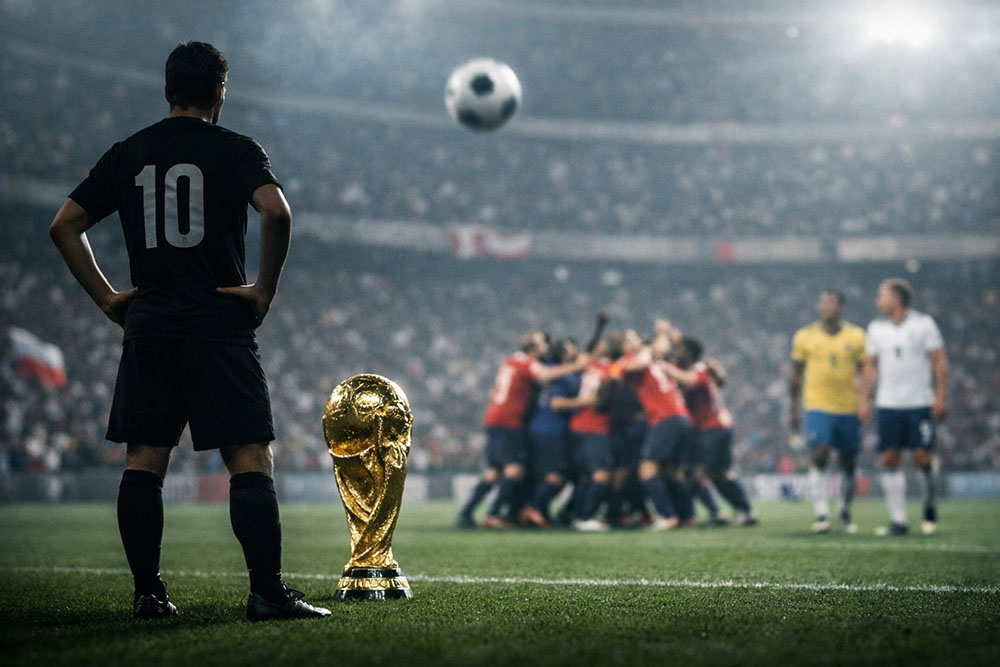
The 2026 FIFA World Cup will be unlike any edition before it. With the tournament expanding from 32 to 48 teams, hosted across the United States, Canada, and Mexico, football fans around the world are asking the same electrifying question: Could this be the year a true dark horse storms the global stage? Not a mild surprise, not a plucky Round‑of‑16 cameo, but a genuine, deep‑run, giant‑killing, history‑rewriting dark horse.
The expanded format changes everything. More teams, more matches, more chaos — and more opportunities for a nation outside the traditional elite to rise. But does expansion actually increase the odds of a Cinderella story, or will the footballing giants still dominate as always? The answer is more complicated than it seems.
Why the 48‑Team Format Opens the Door for a Dark Horse
The new structure introduces 12 groups of four, with 32 teams advancing to the knockout rounds. That means more than half the field survives the group stage — a dramatic shift that reduces early elimination risk for mid‑tier nations.
Several factors make a dark‑horse breakthrough more plausible:
- Lower early pressure — With three group matches and more qualification slots, one unlucky game won’t doom an underdog.
- More diverse matchups — Traditional powers may face unfamiliar opponents, increasing tactical unpredictability.
- Greater global representation — Africa and Asia receive more slots, bringing in teams with explosive athleticism and rising tactical sophistication.
- Tournament fatigue for giants — With more matches overall, depth becomes crucial, and not all big nations have equal bench strength.
In short, the expanded format creates a wider runway for ambitious outsiders.
But Expansion Also Strengthens the Giants
However, it’s not a simple fairy‑tale equation. The same expansion that helps underdogs also benefits the traditional powers:
- Top teams get easier groups, reducing the chance of early upsets.
- More knockout rounds mean more time for quality to prevail — the deeper the tournament goes, the more elite squads tend to dominate.
- Big nations have deeper squads, allowing them to rotate without losing quality.
Historically, even in chaotic tournaments, the semifinals rarely feature more than one surprise team. The World Cup is not the Euros; depth and consistency matter more than a single hot streak.
So the question becomes: Does the expanded format create more chaos, or does it simply give giants more room to breathe?
The Case for a True 2026 Dark Horse
Despite the structural advantages for big teams, several nations stand out as potential dark horses capable of shocking the world. These are not random minnows — they are rising football nations with strong youth development, tactical identity, and growing European‑based talent pools.
Here are the types of teams most likely to break through:
- Athletic African sides with elite physical profiles and increasingly sophisticated coaching.
- Asian nations with disciplined tactical systems and players thriving in Europe.
- North American teams benefiting from home‑continent advantage.
- European mid‑tier nations with golden generations peaking at the right moment.
The expanded format gives these teams more margin for error — and more chances to build momentum.
Why 2026 Might Produce the Most “Open” World Cup in Decades
Several global trends converge in 2026:
1. Talent is more globally distributed than ever
African and Asian players are now regulars in top European leagues. The gap between “elite” and “non‑elite” nations is shrinking.
2. Tactical knowledge is universal
Coaches, analysts, and data tools circulate worldwide. Even smaller nations now play with modern structures — pressing triggers, compact mid‑blocks, and fluid transitions.
3. The travel and climate factor
With matches spread across three vast countries, conditions will vary wildly. Adaptability becomes a weapon, and underdogs often thrive in chaos.
4. The psychological effect of expansion
Big teams may subconsciously relax in the group stage, while underdogs enter with nothing to lose.
All of this creates a perfect storm for unpredictability.
So… Will a True Dark Horse Emerge?
The honest answer: 2026 offers the best chance in decades, but a semifinal run is still the realistic ceiling for most outsiders. A finalist dark horse is possible — but would require:
- A favorable knockout bracket
- A golden generation peaking simultaneously
- A tactically flexible coach
- A goalkeeper having the tournament of his life
- A giant collapsing early
These ingredients have existed before, but the expanded format increases the probability that they align.
If a true dark horse ever reaches a World Cup final again — something we haven’t seen since Croatia in 2018 — 2026 is the likeliest moment.
Final Verdict
The first 48‑team World Cup will not just be bigger — it will be wilder. The expanded structure lowers barriers, increases variance, and gives ambitious nations a real shot at history. While the giants remain favorites, the door for a dark horse has never been more open.
Whether one actually storms through that door is the drama that makes football irresistible.